
Blog
The importance of room automation in an office environment

Nowadays it is a commonplace that offices are ergonomic, as it has been proven that it has a positive impact on workflow, efficiency and even health. However, only few people realize that our health is also affected by other factors.
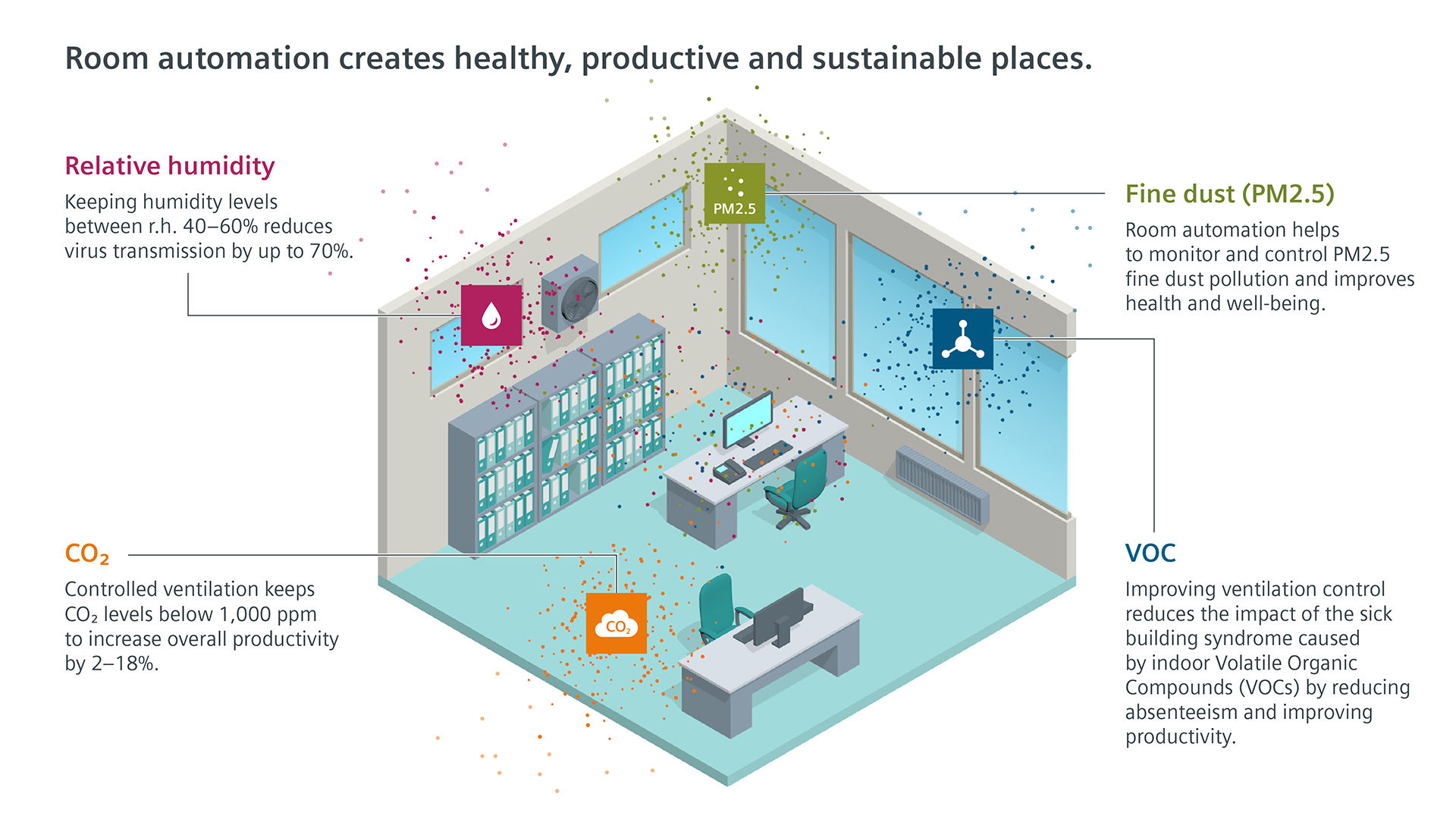
Whether a person feels well in an office or not, also depends on the premise’s automation level. Nowadays having room thermostats is a common phenomenon. With these we can adequately adjust the temperature of the room. Shading controls from room controllers are becoming more common to ensure proper lighting. Adjusting the temperature of a premise is equally as important as measuring and controlling the concentration of relative humidity, CO2, PM2.5 and VOC (meaning: volatile organic compound). Relative humidity is probably the most familiar of the previously mentioned concepts. It is advisable to keep the rate between 40 and 60%; if the rate is too low, it would lead to dehydration (dry eyes, irritation, and throat scratching are typical symptoms), if too high, it would encourage pathogens to grow and lead to mold. The level of CO2 has a significant impact on fatigue: If the air is stale, i.e., the proportion of fresh air is not appropriate, people feel tired, yawn, and their efficiency worsens, so they will be less productive. The concentration of PM2.5 or indoor fine particulate matter and VOCs has a major impact on health and our level of comfort. The elements used in a room (carpets, paint, furniture etc.) play a significant role in both, and it is typically the dust that is trapped and stirred up in these elements and the gases that escape from them that can cause discomfort. If we feel unwell in an office or in a building, and the symptoms only last while we are inside, then the quality of the air is probably bad, and we can be suspicious that the place is suffering from Sick Building Syndrome or SBS. If we experience something like this, it is worth informing our employer, who must investigate the available opportunities in order to improve air quality and comfort.
Author: Andrea Papp electrical engineer
Recent posts
From idea to impact
At IN-EX, we believe that our greatest asset is the knowledge, experience and curiosity of our people. The Innovation Hub was created to ensure that our engineers’ ideas do not remain isolated suggestions: we give them space, develop them together, and take initiatives that create real value all the way through to implementation.
Structural Challenges of an Automated Warehouse System and a BIM-Based Solution
Our project serves as a good example of how adapting existing industrial buildings to modern technologies can present a complex engineering challenge. The implementation of the automated high-bay warehouse system involved not only a technological conversionbut also the adaptation of an existing reinforced concrete hall structure to new operational, structural, and fire safety requirements.
New Technology, Existing Structure: A Steel Structural Solution for the Conversion of an Automated High-Bay Warehouse
During the interior conversion of a high-bay warehouse attached to a manufacturing plant, it became necessary to install a state-of-the-art automated storage system. In the first phase of the project, we were commissioned to assess, at the conceptual design stage, whether the existing structural framework was suitable for accommodating the new technological system and to determine what structural modifications would be required to implement the conversion.
One Office, One Model: The Benefits of 3D Design and Multidisciplinary Collaboration
STUDIO IN-EX is a multidisciplinary design studio where almost every design discipline is represented under one roof. Every day, our colleagues experience the benefits of having designers from different disciplines work side by side, within a shared closed BIM environment and in the same office. What are these benefits in practice? We spoke to Lilla Vámos, one of our low-voltage systems designers, about her experience.
Case Study: Saving on Investment Costs Through Smart Warehouse Design
We believe that the investment cost of a project can be influenced to a significant extent during the design phase. For this reason, our approach goes beyond simply meeting the applicable requirements. We also investigate alternative technical solutions that can provide the same level of technical performance and safety while resulting in lower investment costs.
Model Checking Is Not About Finding Errors
In model-based design, a BIM model is no longer just a 3D representation. A well-structured model contains geometry, information, and discipline-specific relationships in a single source of truth. It drives drawings, quantity take-offs, schedules, equipment lists, technical data deliverables, and serves as the common platform for multidisciplinary coordination.