Blog
Innovative Operational Development Based on BIM

How did we build an integrated digital operating model at STUDIO IN-EX?
On May 14, at the PropTech Hungary Conference and the final of the PropTech Pioneer Awards 2026 in the Corporate Innovator category, we had the opportunity to present the operational approach that STUDIO IN-EX has been developing over the past several years. It is a great honour for us that our submission was awarded 2nd place in the Corporate Innovator category.
For us, this recognition is not about a single software application or development project. Rather, it acknowledges our belief that digital transformation is not a technology project—it is an operational transformation.
The central question of our presentation was simple: How can we design better buildings in an increasingly complex world? The answer, however, is far more complex than simply “using more BIM” or “implementing more software.”
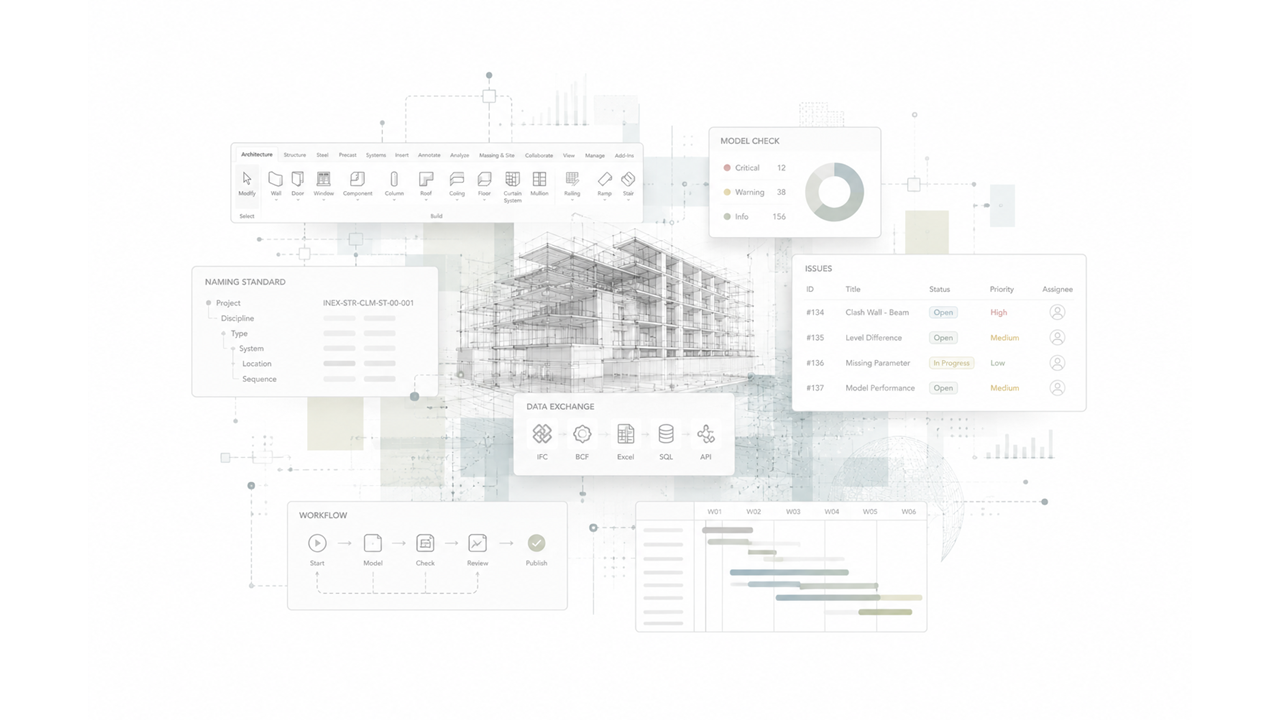
Increasingly complex projects. Unchanged ways of working.
The construction industry has changed dramatically in recent years. Today’s projects involve significantly more stakeholders, data, interdisciplinary interactions, and decision points than ever before. Data volumes continue to grow, project deadlines are becoming tighter, client expectations more demanding, while regulatory requirements are constantly evolving. None of this is inherently a problem.
The real challenge begins when organizations attempt to manage this increased complexity using the same operating model that was sufficient years ago—despite having twice as many project participants, three times as much data, and substantially greater responsibility.
The industry’s response: more tools
Over the past decade, the AEC industry has embraced an impressive range of new technologies.
- BIM.
- Common Data Environment (CDE) platforms.
- Parametric design.
- Automation.
- Low-code platforms.
- Artificial Intelligence.
All of these are valuable technologies. Yet many organizations continue to struggle with the same fundamental problems.
Why?
A common pattern is that the introduction of new technologies is not accompanied by a redesign of the way the organization actually works. Existing processes are simply transferred into a digital environment while organizational boundaries, responsibilities, and communication patterns remain unchanged. In these cases, technology does not eliminate inefficiencies—it merely reproduces them faster.
The problem is not BIM
We often hear the statement: “BIM doesn’t work.” We see it differently. BIM works. The tools work. The problem is not the technology itself. The real issue emerges when an organization reaches the natural limits of its operational model. Beyond a certain scale, exceptions become increasingly common. Manual interventions multiply. Temporary workarounds become permanent. Individual teams develop their own processes. At that point, the question is no longer which software to use. The real question is whether the organization is capable of viewing its own operations as an integrated system.
The three pillars of digital operations
One of our most important realizations over the past few years has been that digital operations are built on much more than technology.
OPERATIONS: First, the organization must understand how it wants to work. How is information managed? How are decisions made? Where do responsibilities begin and end? Which rules are standardized across the organization, and where is flexibility allowed?
ORGANIZATION: Next comes the organizational layer responsible for maintaining, governing, improving, and standardizing these operational principles. Only after this foundation has been established does technology become truly effective.
TECHNOLOGY: Technology delivers value only when it is built upon a clear and consistent operational framework.
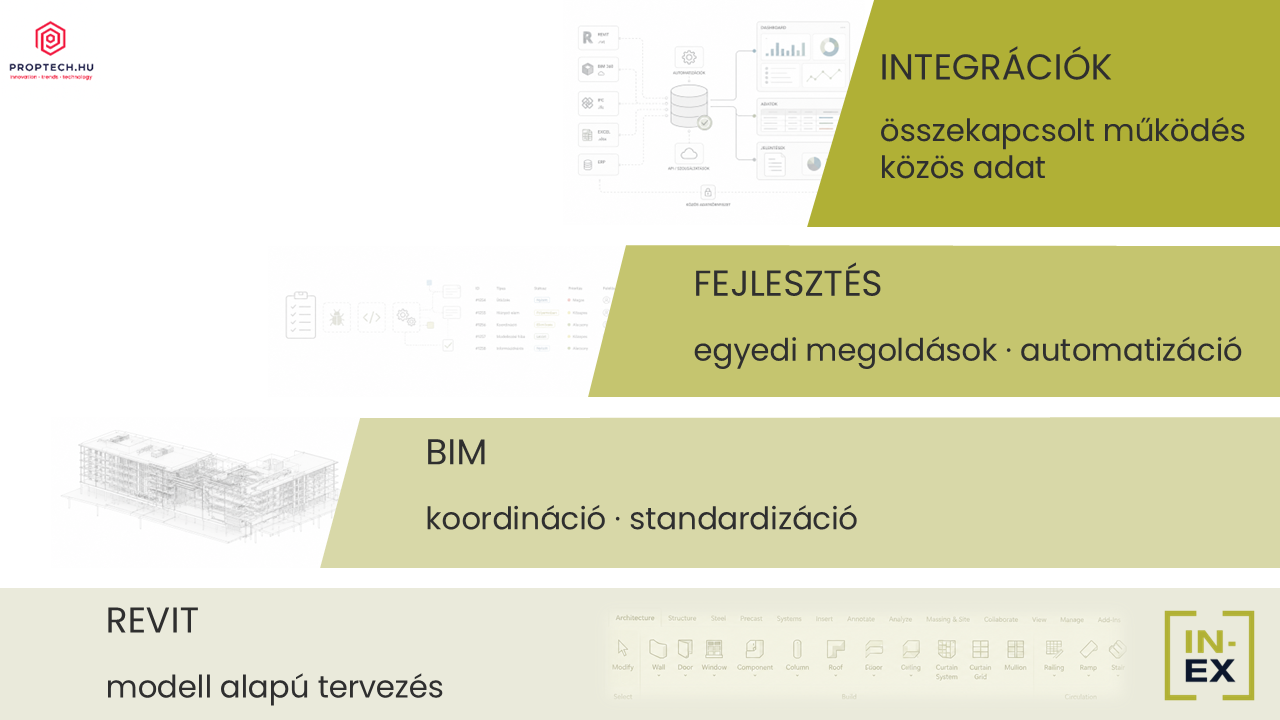
How did we get here?
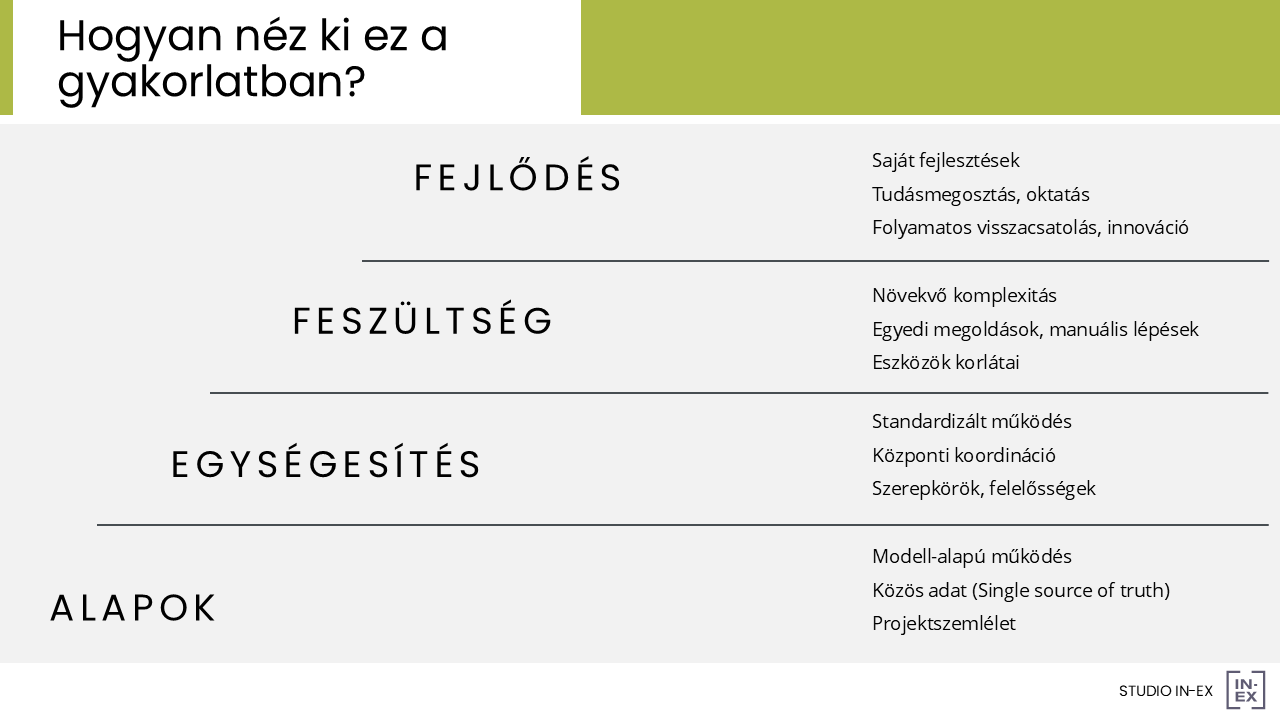
The evolution of STUDIO IN-EX was not the result of one major breakthrough, but rather a sequence of interconnected steps.
Model-based design has been part of our daily operations for more than a decade. Every engineering discipline works in Autodesk Revit using model-based documentation.
Once this foundation had matured, we established a dedicated BIM organization not to create additional rules, but to standardize operational processes, define roles and responsibilities, coordinate knowledge sharing, and continuously improve workflows. Automation came next.
Initially, we developed small Revit add ins. These gradually evolved into increasingly sophisticated solutions, eventually leading to the establishment of a dedicated software development infrastructure and an in-house development team. This was the real turning point.
Instead of building isolated applications, we began designing operational systems.
Integrated operations
One of the central messages of our presentation was that the objective is not simply a well-functioning BIM environment. The real objective is integrated operations. An operating model where not only data, but also processes, roles, digital tools, and development decisions are interconnected.
This means recurring issues, operational bottlenecks, and improvement opportunities are no longer treated as isolated problems. Instead, they are analysed within the context of the entire organization. Where does the problem originate? Which process does it affect? Who owns the responsibility? Which existing digital infrastructure must the solution integrate with?
Within an integrated operating model, a new automation, workflow, or rule is never introduced as a standalone feature. Instead, it becomes part of the existing ecosystem of processes, data structures, and operational standards. As a result, development is no longer about rigid standardization. It becomes a sustainable operational framework that can continuously evolve, address current challenges, and remain adaptable to future requirements.
Continuous improvement is not a project—it is the way we work
Many organizations approach innovation as a series of dedicated development projects. We take a different approach. Continuous improvement is not a campaign or a one-time investment—it is embedded in our daily operations. Our employees continuously provide feedback. We measure how our digital tools are used. We analyse operational processes. Whenever a problem repeatedly occurs, we do not simply introduce another rule. We seek to eliminate its root cause. This is how our developments are created. New systems are not developed because the technology is interesting, but because they solve genuine operational pain points.
Automation as a natural consequence
True automation becomes possible only after operations have been standardized. Many organizations attempt the opposite approach—they try to automate chaotic processes. The result is usually nothing more than faster chaos.
Our philosophy is different.
First, we standardize the way we work. Only then do we automate. As a result, automation is no longer an isolated productivity feature—it becomes a natural extension of everyday operations.
Three examples of the same philosophy
At first glance, Project Progress, Document Register, and BOKU appear to be three completely different solutions. In reality, they are all manifestations of the same operational philosophy.
Project Progress transforms more than twenty years of historical project data into a decision-support platform. Rather than simply producing reports, it enables better planning of future projects by supporting resource forecasting and proposal preparation.
Document Register is far more than a document management application. It provides an operational framework that ensures documents are created according to consistent structures from the very beginning. Document management therefore becomes an essential platform for quality assurance and operational control rather than an administrative task.
BOKU eliminates a disconnect that has existed for decades between BIM models and Bills of Quantities (BoQs). The BIM model and the quantity take-off are finally generated from the same source of information, while design changes become automatically traceable throughout the documentation process.
These are not simply automation tools. They are integrated operational systems designed to support everyday engineering practice.




The most important development is the operating model itself
The systems presented do not make an organization innovative on their own. The real value lies in an operating model capable of identifying recurring problems, translating them into development priorities, and delivering solutions that integrate seamlessly with existing processes, data structures, and organizational responsibilities.
For this reason, digital transformation at STUDIO IN-EX is not about implementing standalone technologies.
A new automation, reporting tool, model validation rule, or internal application creates value only when it becomes an integral part of project delivery—intervening at the right point in the process, delivering information to the right people, and supporting engineering workflows in a sustainable, long-term manner.
From this perspective, innovation is not a one-time achievement. It is an organizational capability built upon continuous feedback, conscious prioritization, standardized operational foundations, and automation that supports—not replaces—engineering expertise.
Where do we go from here?
We believe the construction industry is no longer approaching another technological revolution. It is approaching an operational transformation.
Success in the coming years will not depend on which organizations adopt more Artificial Intelligence or deploy more BIM tools.
It will depend on which organizations are capable of establishing common operational principles, transforming knowledge into scalable systems, and continuously measuring, evaluating, improving, and automating the way they work.
This is the path we have chosen.
Author: Gyimesi Gergő, BIM Studioleader
Recent posts
One Office, One Model: The Benefits of 3D Design and Multidisciplinary Collaboration
STUDIO IN-EX is a multidisciplinary design studio where almost every design discipline is represented under one roof. Every day, our colleagues experience the benefits of having designers from different disciplines work side by side, within a shared closed BIM environment and in the same office. What are these benefits in practice? We spoke to Lilla Vámos, one of our low-voltage systems designers, about her experience.
Case Study: Saving on Investment Costs Through Smart Warehouse Design
We believe that the investment cost of a project can be influenced to a significant extent during the design phase. For this reason, our approach goes beyond simply meeting the applicable requirements. We also investigate alternative technical solutions that can provide the same level of technical performance and safety while resulting in lower investment costs.
Model Checking Is Not About Finding Errors
In model-based design, a BIM model is no longer just a 3D representation. A well-structured model contains geometry, information, and discipline-specific relationships in a single source of truth. It drives drawings, quantity take-offs, schedules, equipment lists, technical data deliverables, and serves as the common platform for multidisciplinary coordination.
Innovative Operational Development Based on BIM
We had the opportunity to present at the PropTech Hungary 2026 Conference the operational approach that STUDIO IN-EX has been developing over the past several years. It is a great honour for us that our submission was awarded 2nd place in the Corporate Innovator category.
Challenges in waterproofing design
Our task in this project was to prepare the detailed design documentation for the expansion of a pharmaceutical manufacturing plant. A major technical challenge during the design phase was that the development area is located in the floodplain of the Gyöngyös stream.
Symbiosis at the Design Table: How Mechanical Engineering and Building Automation Merged at STUDIO IN-EX
One of the greatest advantages of a closed BIM based design process is its ability to continuously reveal new opportunities for improvement.