Blog
Model Checking Is Not About Finding Errors

In model-based design, a BIM model is no longer just a 3D representation. A well-structured model contains geometry, information, and discipline-specific relationships in a single source of truth. It drives drawings, quantity take-offs, schedules, equipment lists, technical data deliverables, and serves as the common platform for multidisciplinary coordination.
For this reason, model checking at IN-EX is not treated as a separate technical task. It is an integral part of our design quality assurance process. When drawings, schedules, and a significant portion of project data are generated directly from the model, the quality of the model directly determines the quality of the design documentation.
Model Quality Equals Design Quality
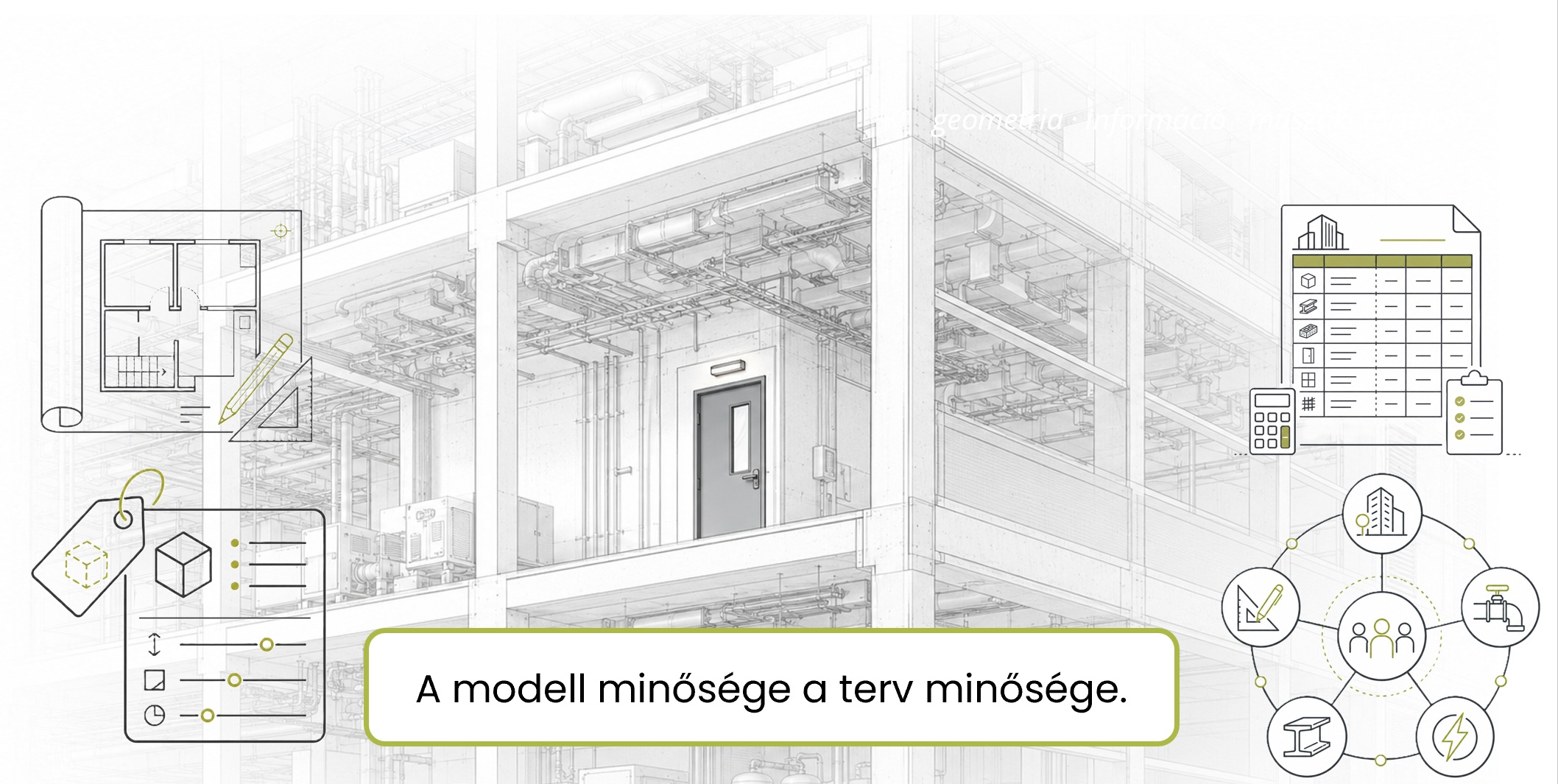
Traditional design checking primarily focuses on drawings and technical documentation. In a model-based workflow, however, much of the design information already exists within the BIM model. Element locations, dimensions, relationships, parameters, and metadata are all propagated into the project documentation.
As a result, model errors rarely remain confined to the model itself. An incorrectly placed element, an inaccurate dimension, a missing technical parameter, or an incorrect classification can all appear in drawings, schedules, data exports, or even in client deliverables.
At IN-EX, we therefore regard model checking as a digital extension of the design checking process.
We Check More Than Geometry
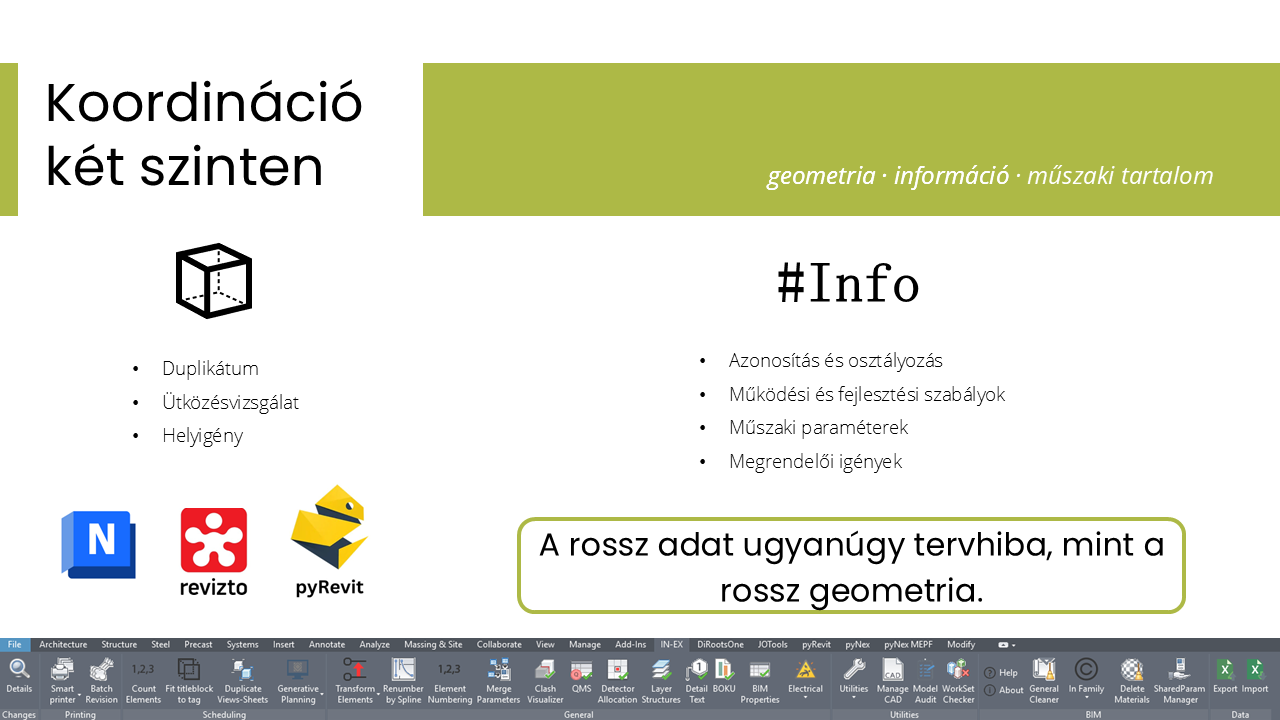
When people think about model checking, clash detection is usually the first thing that comes to mind. It remains an essential part of the process. We verify element locations, dimensions, clearances, relationships, duplicate objects, and incorrectly placed components. However, BIM quality assurance goes far beyond geometric coordination. Information coordination is just as important as geometry coordination.
This means we do not only verify whether an element is in the correct location. We also check whether it can be uniquely identified, whether it belongs to the correct system, whether its technical parameters are complete and accurate, whether it complies with our internal modelling standards, and whether it satisfies the client’s information requirements.
Simply put, incorrect data is just as much a design error as incorrect geometry.
A Report Has No Value by Itself
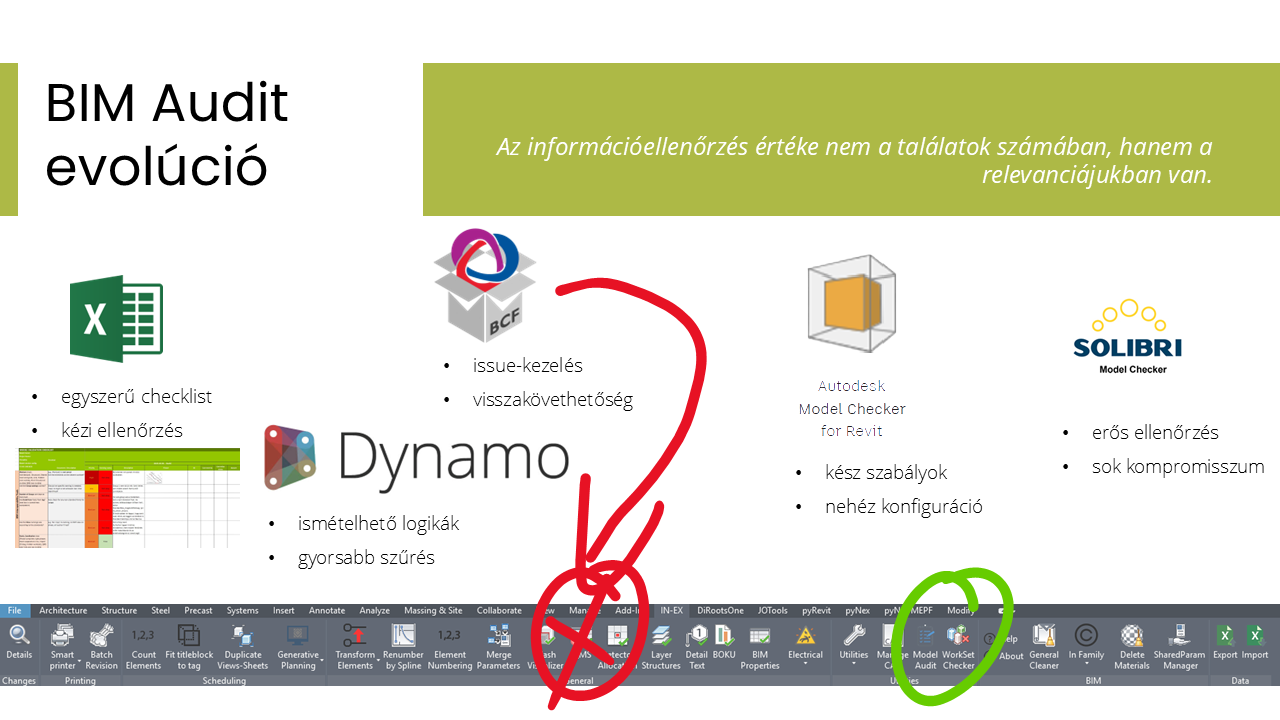
Automated model checking tools can generate extensive lists of issues within seconds. However, a long issue report does not automatically translate into effective quality assurance.
At IN-EX, the value of model checking lies not in the number of detected issues, but in their relevance. The objective is not to identify as many discrepancies as possible, but to highlight the issues that truly matter, group them logically, and present them to designers in a way that supports efficient resolution.
A report, by itself, has little value. The real value is created when identified issues lead to actual improvements in the model.
Model Auditing Based on Project-Specific Rules
At IN-EX, model auditing is not a generic error-hunting exercise. It is based on the rules that are relevant to our workflows, projects, and digital ecosystem.
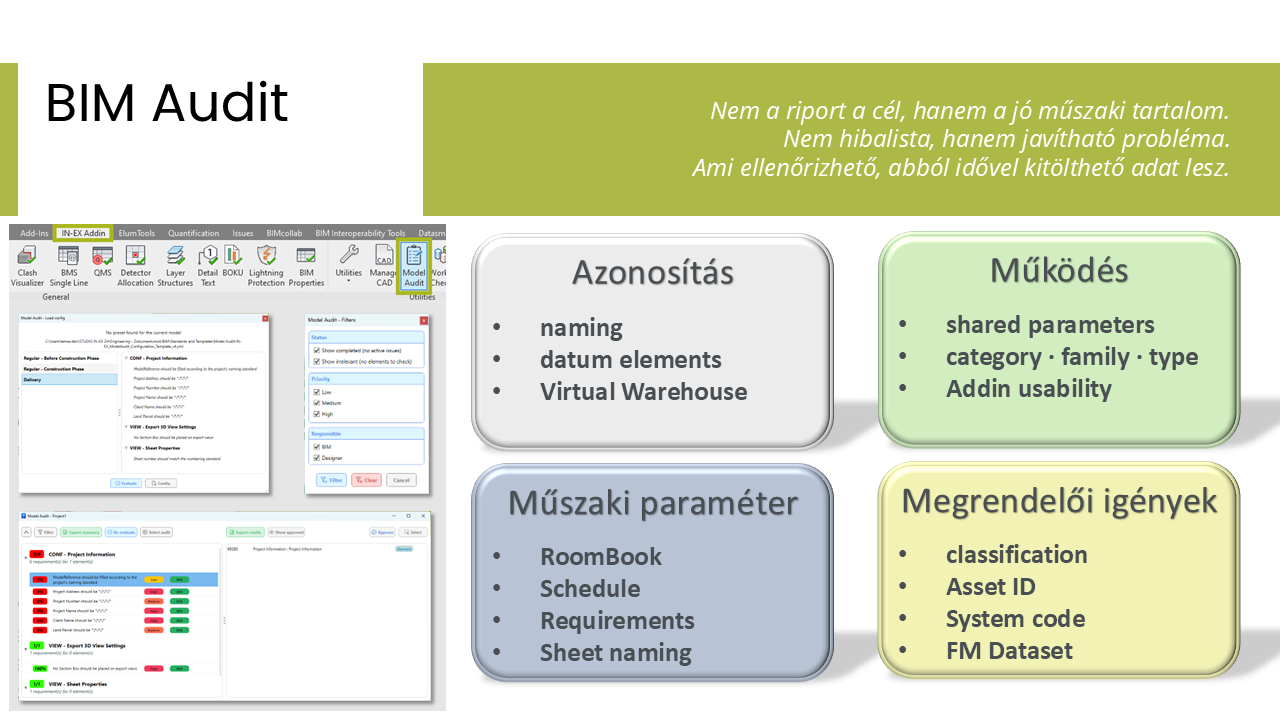
This process consists of several layers.
The first layer is identification. We verify naming conventions, system structure, level and workset assignments, and, whenever possible, the use of model elements from our internal content library. If an element cannot be uniquely identified, it cannot be reliably filtered, scheduled, checked, or exchanged later in the project.
The second layer focuses on functionality. We validate shared parameters, the consistency between categories, families and types, and all prerequisites required for schedules, tags, add-ins, and automated workflows to function correctly.
The third layer addresses technical data quality. We verify dimensions, materials, capacities, performance values, design requirements, and other discipline-specific properties, ensuring that the required information is present, complete, and reliable. At this level, data quality directly affects the technical quality of the design.
The fourth layer focuses on client information requirements. This includes classifications, Asset IDs, system codes, and complete Facilities Management (FM) data deliverables where required. It is not enough for the information to exist somewhere in the model—it must be stored in the correct location, in the correct format, and in a way that can be consistently validated and exported.
The Goal of Model Checking Is Prevention
An effective model audit does more than identify issues – it helps improve the design process itself. When the same problem occurs repeatedly, simply reporting it again is not enough. The root cause must be understood so that workflows, templates, tools, or data structures can be improved, preventing the issue from recurring or significantly reducing its frequency.
For this reason, the objective at IN-EX is not merely to find errors. We continuously develop a digital design environment in which automated model checking leads to higher data quality, more reliable BIM models, and better design documentation.
The most effective model check is the one that eventually makes itself unnecessary by preventing errors before they occur.
Gergő Gyimesi, BIM Studioleader
Recent posts
From idea to impact
At IN-EX, we believe that our greatest asset is the knowledge, experience and curiosity of our people. The Innovation Hub was created to ensure that our engineers’ ideas do not remain isolated suggestions: we give them space, develop them together, and take initiatives that create real value all the way through to implementation.
Structural Challenges of an Automated Warehouse System and a BIM-Based Solution
Our project serves as a good example of how adapting existing industrial buildings to modern technologies can present a complex engineering challenge. The implementation of the automated high-bay warehouse system involved not only a technological conversionbut also the adaptation of an existing reinforced concrete hall structure to new operational, structural, and fire safety requirements.
New Technology, Existing Structure: A Steel Structural Solution for the Conversion of an Automated High-Bay Warehouse
During the interior conversion of a high-bay warehouse attached to a manufacturing plant, it became necessary to install a state-of-the-art automated storage system. In the first phase of the project, we were commissioned to assess, at the conceptual design stage, whether the existing structural framework was suitable for accommodating the new technological system and to determine what structural modifications would be required to implement the conversion.
One Office, One Model: The Benefits of 3D Design and Multidisciplinary Collaboration
STUDIO IN-EX is a multidisciplinary design studio where almost every design discipline is represented under one roof. Every day, our colleagues experience the benefits of having designers from different disciplines work side by side, within a shared closed BIM environment and in the same office. What are these benefits in practice? We spoke to Lilla Vámos, one of our low-voltage systems designers, about her experience.
Case Study: Saving on Investment Costs Through Smart Warehouse Design
We believe that the investment cost of a project can be influenced to a significant extent during the design phase. For this reason, our approach goes beyond simply meeting the applicable requirements. We also investigate alternative technical solutions that can provide the same level of technical performance and safety while resulting in lower investment costs.
Model Checking Is Not About Finding Errors
In model-based design, a BIM model is no longer just a 3D representation. A well-structured model contains geometry, information, and discipline-specific relationships in a single source of truth. It drives drawings, quantity take-offs, schedules, equipment lists, technical data deliverables, and serves as the common platform for multidisciplinary coordination.