Blog
From idea to impact

The Innovation Hub and organisational innovation at STUDIO IN-EX
Innovation is not simply a new technology or a spectacular invention. It often begins with an everyday observation: something could be done more simply, quickly, safely or to a higher standard.
What does innovation mean in practice?
One of the most important aspects of innovation is implementation. An idea alone is not yet innovation: it becomes innovation when it is turned into a practical solution that creates measurable or tangible value. That value might take the form of a new service, a better design method, more transparent operations, fewer repetitive tasks, a lower risk of errors or even smoother collaboration.
Innovation is therefore not solely a technological matter. Rethinking a process, sharing knowledge more effectively, removing an organisational obstacle or making more purposeful use of an existing tool can all be forms of innovation. The scale of the change is not necessarily what matters; what matters is whether it provides a meaningful response to a real problem.
The problem is not a lack of ideas
In a multidisciplinary design firm, different professional perspectives, project experience and operational situations come together every day. Employees see first-hand where a process is slow, where the same work is repeated unnecessarily, where information is missing, or where there may be an opportunity for a better solution. This continuously generates new ideas.
The real challenge is what happens to those ideas. Suggestions that arise in corridor conversations, meetings or messages can easily get lost. At other times, an idea may appear promising, but it is unclear how many people it affects, what conditions are required, who could take it forward, or how it aligns with the organisation’s objectives. Managing good ideas is therefore at least as important as generating them.
Moreover, not every initiative requires the same level of attention. Some can deliver rapid improvement with little effort, while others require collaboration across several disciplines, more extensive preparation or a strategic decision. The task is to avoid assessing them all by a single measure, while ensuring that decisions remain traceable and resources can be used deliberately.

A shared framework for initiatives
The evaluation of an innovation idea can be highly detailed: it may include a return-on-investment calculation, a business impact assessment, research into technology and licensing, risk analysis, resource estimates and a fully developed implementation proposal. Many innovation practices – particularly in IT or for larger investments – follow this logic, and it can work well in the right environment.
Based on our experience, however, this level of preparation cannot be expected from every idea owner. Someone who encounters a problem directly may understand its impact very clearly, while not necessarily having the technological knowledge, market information, supplier relationships or financial data required for a full evaluation. If a completely developed proposal were a prerequisite for submission, we could easily lose valuable insights that, with the right professional support, might become genuine improvements.
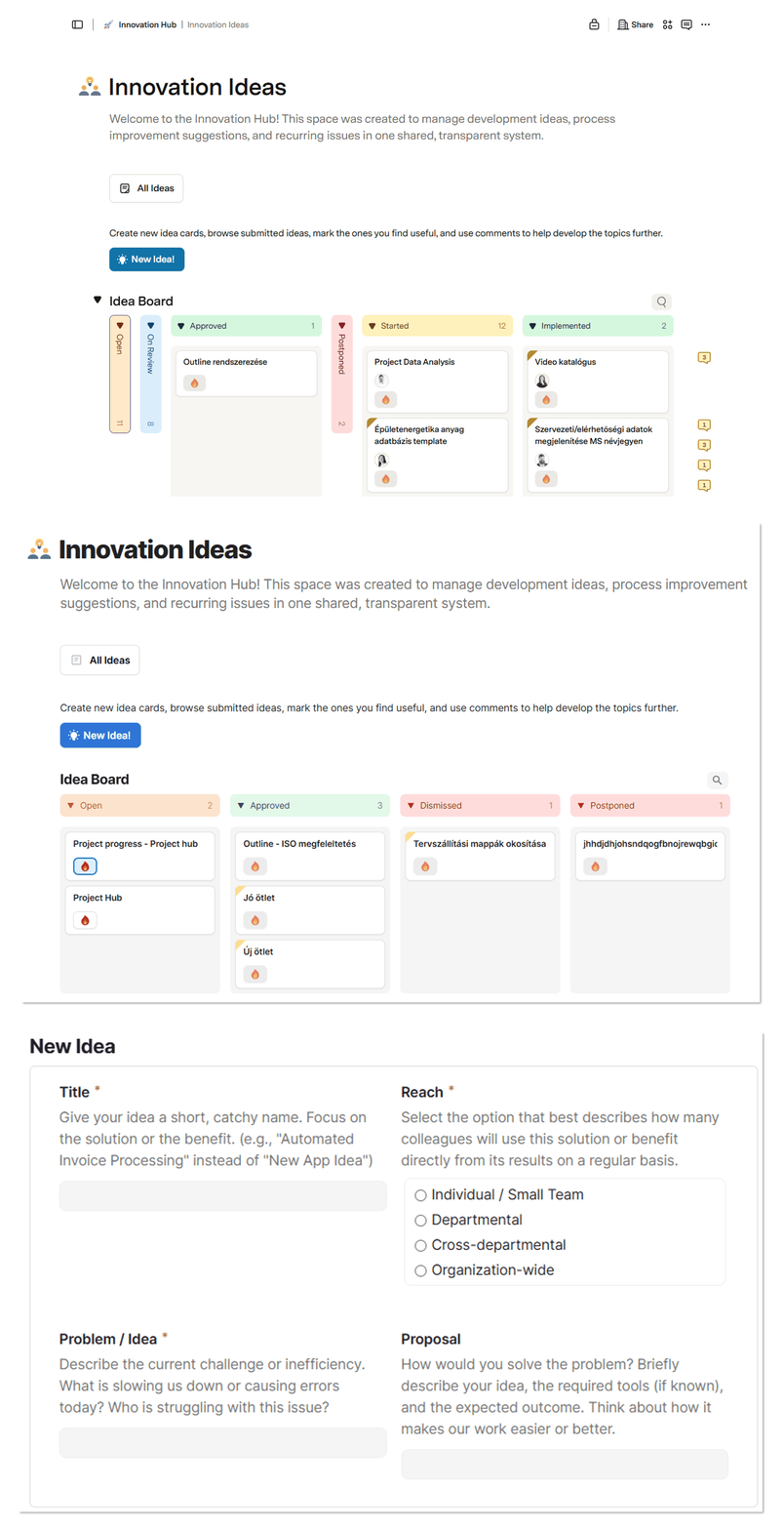
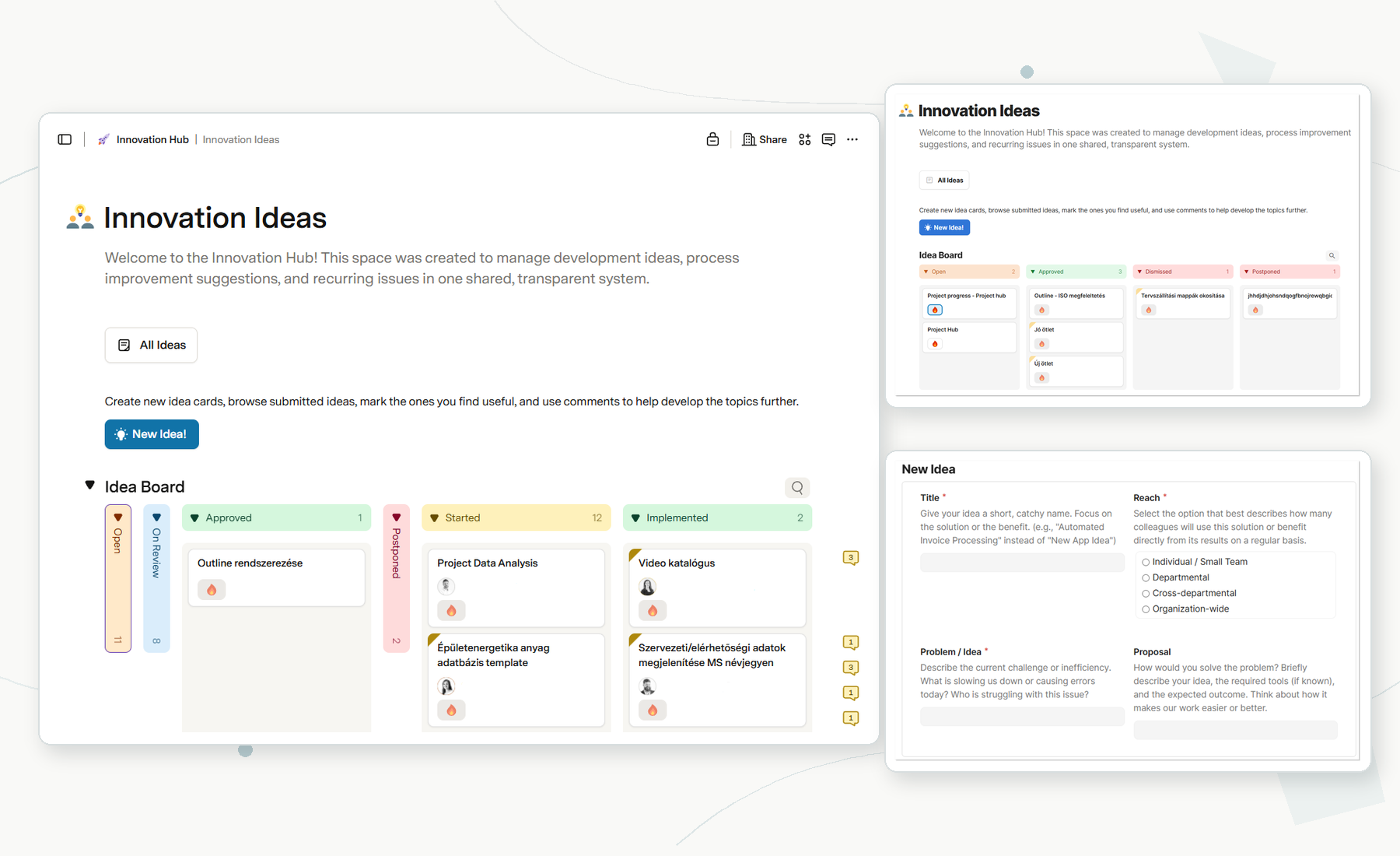
We created the IN-EX Innovation Hub to address this challenge: a shared framework that makes employees’ improvement proposals, recurring problems and innovation initiatives visible and traceable. The barrier to entry is deliberately low. Nobody is expected to arrive with a finished business plan or a fully developed solution. Many valuable improvements begin with a well-defined problem. Simply knowing what regularly causes difficulty, who it affects and why it deserves attention is already important information.
- Every submission begins with a short idea card. Initially, the card captures the essence and anticipated scope of the initiative, then expands gradually as the topic progresses.
- Where needed, we involve subject-matter representatives and experts with relevant experience. They help us understand the background to the problem, assess feasibility, explore possible technological or operational solutions, and estimate the expected impact and resource requirements. Detailed preparation is therefore not solely the responsibility of the idea owner, but the result of a collaborative professional effort.
- Colleagues can explore the ideas, add comments and indicate which initiatives they consider particularly useful. This community feedback does not determine implementation on its own, but it provides an important indication of how widely a problem is experienced, what additional insights relate to it, and how much support there is for a potential change.
- The Innovation Board decides on prepared initiatives by considering their anticipated benefits, feasibility, resource requirements, risks and alignment with organisational objectives.
- Throughout the process, the status of ideas, key feedback and the reasoning behind decisions remain traceable. For us, transparency does not mean making every internal analysis or piece of decision-support data public. It means ensuring that both the idea owner and the wider community understand what is happening to a submission: why it is progressing, why it requires further investigation, or why it is not being implemented at this stage.
This means we do not need to know everything in advance, yet we can still reach a thoroughly considered, multi-faceted and traceable decision about exactly what change we want to achieve – and the best way to get there.
Innovation is also organisational learning
The value of the Innovation Hub lies not only in the individual ideas that are implemented. Taken together, the submitted topics also reveal which issues matter to the organisation, where recurring difficulties arise, and which areas may warrant systemic change. A single card may represent a local concern, but several similar signals can reveal an important pattern.
We therefore do not regard the way the Hub operates as a finished construct. The Innovation Hub itself continues to evolve based on experience, user feedback and the outcomes of implemented initiatives. This reflects the same mindset we apply to innovation as a whole: start with a clearly identified problem, test a solution, learn from the outcome and then improve it further.
IN-EX Innovation Hub: turning ideas into value
The professional expertise, innovative technological environment and experience within IN-EX naturally create opportunities for improvement. The Innovation Hub helps ensure that these do not remain isolated suggestions, but instead lead to shared thinking, well-founded decisions and – where they create real value – tangible change.
Ultimately, innovation becomes part of an organisation’s way of working not because it has many ideas, but because it is able to give them proper attention, learn from them and consistently turn the best ones into value.
Author: Gergő Gyimesi, BIM Studio Leader
Recent posts
From idea to impact
At IN-EX, we believe that our greatest asset is the knowledge, experience and curiosity of our people. The Innovation Hub was created to ensure that our engineers’ ideas do not remain isolated suggestions: we give them space, develop them together, and take initiatives that create real value all the way through to implementation.
Structural Challenges of an Automated Warehouse System and a BIM-Based Solution
Our project serves as a good example of how adapting existing industrial buildings to modern technologies can present a complex engineering challenge. The implementation of the automated high-bay warehouse system involved not only a technological conversionbut also the adaptation of an existing reinforced concrete hall structure to new operational, structural, and fire safety requirements.
New Technology, Existing Structure: A Steel Structural Solution for the Conversion of an Automated High-Bay Warehouse
During the interior conversion of a high-bay warehouse attached to a manufacturing plant, it became necessary to install a state-of-the-art automated storage system. In the first phase of the project, we were commissioned to assess, at the conceptual design stage, whether the existing structural framework was suitable for accommodating the new technological system and to determine what structural modifications would be required to implement the conversion.
One Office, One Model: The Benefits of 3D Design and Multidisciplinary Collaboration
STUDIO IN-EX is a multidisciplinary design studio where almost every design discipline is represented under one roof. Every day, our colleagues experience the benefits of having designers from different disciplines work side by side, within a shared closed BIM environment and in the same office. What are these benefits in practice? We spoke to Lilla Vámos, one of our low-voltage systems designers, about her experience.
Case Study: Saving on Investment Costs Through Smart Warehouse Design
We believe that the investment cost of a project can be influenced to a significant extent during the design phase. For this reason, our approach goes beyond simply meeting the applicable requirements. We also investigate alternative technical solutions that can provide the same level of technical performance and safety while resulting in lower investment costs.
Model Checking Is Not About Finding Errors
In model-based design, a BIM model is no longer just a 3D representation. A well-structured model contains geometry, information, and discipline-specific relationships in a single source of truth. It drives drawings, quantity take-offs, schedules, equipment lists, technical data deliverables, and serves as the common platform for multidisciplinary coordination.