Blog
Symbiosis at the Design Table: How Mechanical Engineering and Building Automation Merged at STUDIO IN-EX

One of the greatest advantages of a closed BIM-based design process is its ability to continuously reveal new opportunities for improvement. At IN-EX, the close collaboration of our nine engineering disciplines has now reached another milestone: by integrating our Mechanical Engineering (MEC) and Building Management System (BMS) disciplines, we have taken efficiency and data integrity to the next level.
Traditionally, Building Management Systems (BMS) have been associated with the Low Voltage (LVO) design disciplines. However, experience gained over recent years, combined with the evolving demands of modern building operation, has highlighted a fundamental fact: truly integrated, energy-efficient buildings that perform reliably throughout their lifecycle depend on the seamless integration of mechanical systems and building automation.
To elevate this integration to the highest level, we dedicated the past several months of development efforts to a bold—but entirely logical—step: merging the MEC and BMS models into a single, shared model.
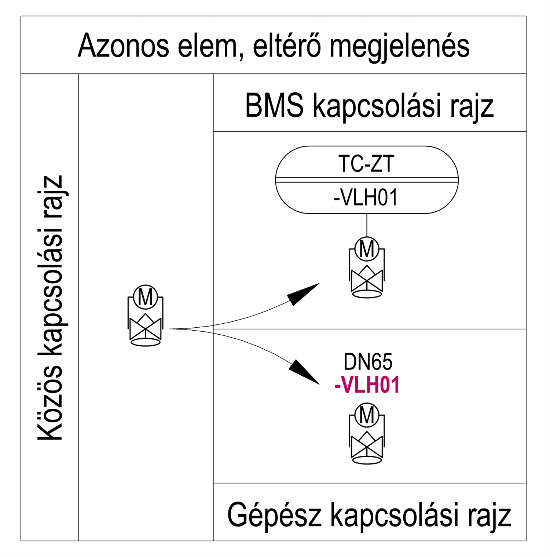
The essence of this development is the elimination of duplicate data. From now on, the underlying structure of our single line diagrams—including codes and symbols—is fully unified. The models are not just similar: the mechanical and building automation symbols are, in fact, the very same model element, with discipline-specific parameters displayed according to the needs of each engineering team.
Within the shared model, the workflow is clear and fully traceable:
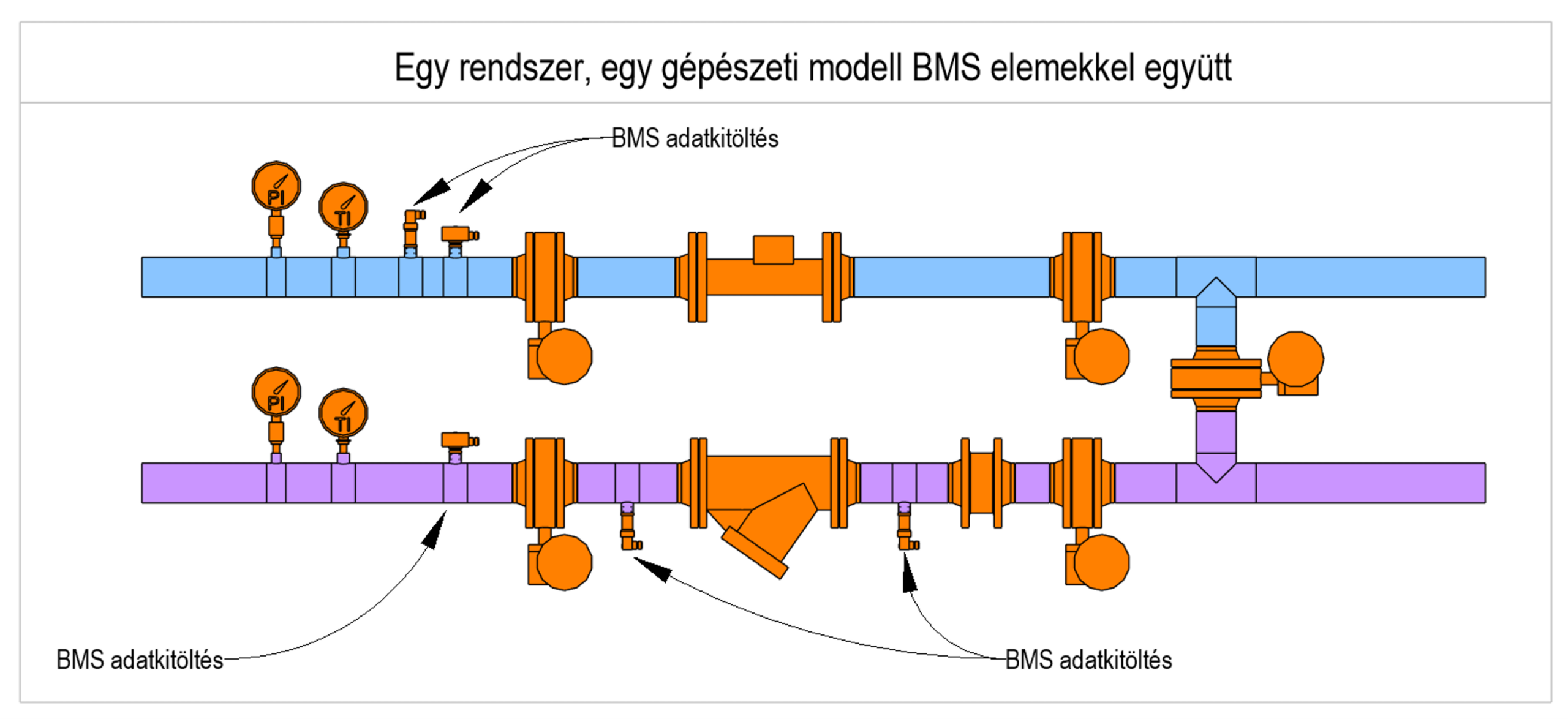
- The Mechanical Engineering (MEC) team places sensors, transmitters, and motorized control valves in their physical locations, establishing the system-level foundation.
- The Building Management System (BMS) team then enriches these same elements by assigning the exact product type, manufacturer, and all control-specific parameters required for automation.
Eliminating the “Fire Damper Effect” and Communication Errors
Like most engineering firms, we previously faced recurring challenges related to manual data coordination between disciplines. A typical example involved fire dampers: the mechanical engineer named and coded the elements, the BMS engineer corrected the identifiers within their own workflow, and then sent the updates back to the mechanical team for manual implementation. At that point, human error inevitably became a risk—the updates were either applied on time or overlooked due to tight project deadlines.
This source of error is now a thing of the past.
Thanks to the live, shared model, synchronization is both immediate and bidirectional:
If a BMS engineer updates a code, the change is instantly reflected in the mechanical single line diagram.
If the mechanical engineer modifies the system, the update appears immediately on the BMS side as well.
Why Does This Matter for Owners and Facility Managers?
The benefits of this development extend well beyond the design office. By dramatically reducing the potential for errors, we deliver more accurate construction documentation, resulting in fewer on-site improvisations, reduced rework, and lower construction costs.
The biggest beneficiaries, however, are the building owner and the future facility management (FM) team. The Single Source of Truth established during the design phase ensures that the completed building’s digital twin—its as-built model—contains reliable, validated data throughout. This creates a trustworthy digital asset that forms the foundation for intelligent, energy-efficient building operation.
At STUDIO IN-EX, we believe that closed BIM is not a static methodology but a continuous process of optimization. This latest development demonstrates that there is always room for even greater accuracy, deeper integration, and smarter engineering.
Author: Norbert Pekola, Studio Leader
Recent posts
Case Study: Saving on Investment Costs Through Smart Warehouse Design
We believe that the investment cost of a project can be influenced to a significant extent during the design phase. For this reason, our approach goes beyond simply meeting the applicable requirements. We also investigate alternative technical solutions that can provide the same level of technical performance and safety while resulting in lower investment costs.
Model Checking Is Not About Finding Errors
In model-based design, a BIM model is no longer just a 3D representation. A well-structured model contains geometry, information, and discipline-specific relationships in a single source of truth. It drives drawings, quantity take-offs, schedules, equipment lists, technical data deliverables, and serves as the common platform for multidisciplinary coordination.
Innovative Operational Development Based on BIM
We had the opportunity to present at the PropTech Hungary 2026 Conference the operational approach that STUDIO IN-EX has been developing over the past several years. It is a great honour for us that our submission was awarded 2nd place in the Corporate Innovator category.
Challenges in waterproofing design
Our task in this project was to prepare the detailed design documentation for the expansion of a pharmaceutical manufacturing plant. A major technical challenge during the design phase was that the development area is located in the floodplain of the Gyöngyös stream.
Symbiosis at the Design Table: How Mechanical Engineering and Building Automation Merged at STUDIO IN-EX
One of the greatest advantages of a closed BIM based design process is its ability to continuously reveal new opportunities for improvement.
The Art of Accountability at IN-EX: Transforming Control into Motivation
For us, accountability is not a tool of fear, but one of professional security. When tasks are clear (SMART) and feedback is fact-based and constructive (AID), team members know exactly where they stand, where they excel, and where they still need to grow. This is how accountability becomes an internal, supportive driving force.