
Blog
Shading the pilgrimage route, Mina, Saudi Arabia

Our office has been commissioned to design the shading of the religious pilgrimage route linking Mount Arafat to Mecca in Mina, Saudi Arabia. The primary aim of the investment was to make the long and arduous walk more comfortable for the pilgrims. We had to design the shading in a way that local contractors could build a timeless system as easily and accurately as possible.
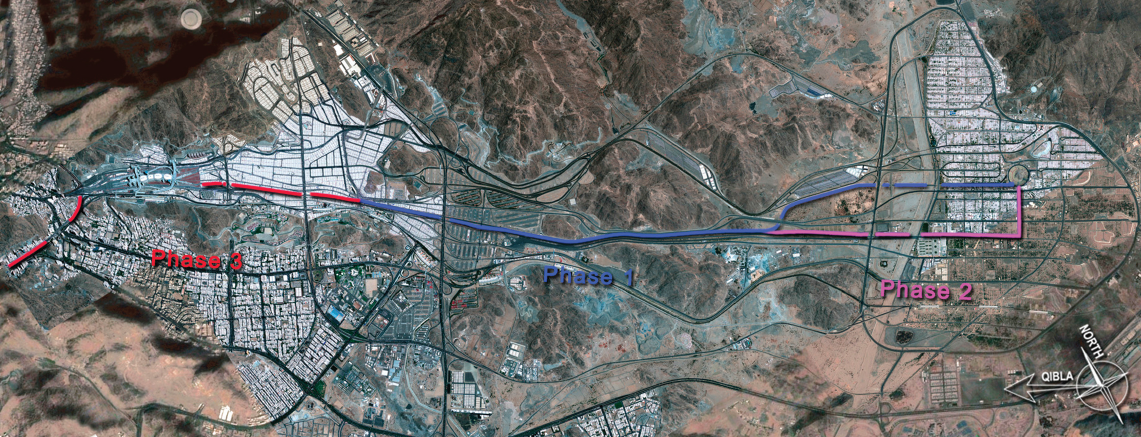
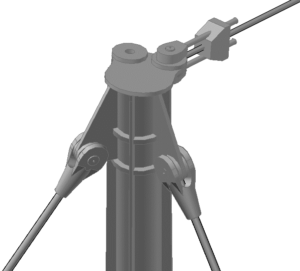
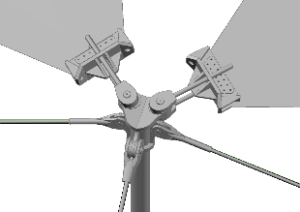
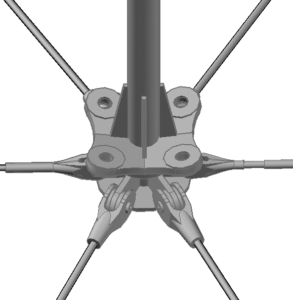
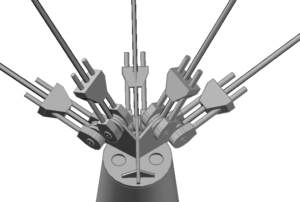
The site is huge in architectural scale; we designed nearly 600,000 square metres of shading over the 30m wide and 20 km long pilgrimage route. Studio IN-EX is responsible for the architecture and the design coordination of this unconventional design project, which also had to meet local needs. The structural design was led by Dr. Dezső Hegyi, a renowned designer, espacially in the field of tent and membrane structures. The biggest challenge for us was to create a typified system of mostly uniform elements that could be easily assembled on site, along the entire length of the road, adapting to the changing environmental conditions – junctions, bends with different angles, tunnels, bridges, roadside rocks, landmarks. The solution was found in a membrane system stretched on a steel frame structure on masts, with uniform elements that can be prefabricated and easily constructed on each section of the road, based on easy-to-understand installation drawings.
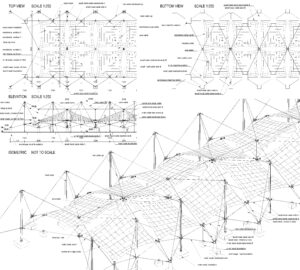
In line with the construction schedule, the area was divided into zones corresponding to the construction phases. In addition to the zones, economic feasibility was also an important objective, so we aimed to ensure that each module could stand on its own without the need to double the supporting columns and beams. We designed the system with as few different types of elements as possible, so we ended up with 2 main module units, which could cover the whole distance complemented by a few individual elements in specific locations.
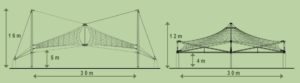
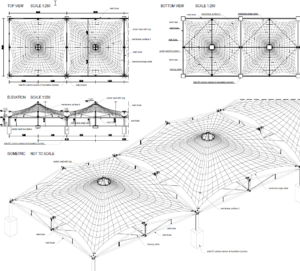
On the general, the desert section of the road, we chose a solution without internal supports, which does not impede the free flow of pilgrims. Since the repetitive module sizes had to cover large spans (30x30m), this was solved by “tying” the structure to the side, using so-called tieback anchoring. In urban areas, where anchoring was not possible due to space constraints, but the faster flow of the uprushing mass required the use of lanes, we provided support by using central columns.
In these sections, two 15-metre-wide flow zones (equivalent to about 5 traffic lanes) were created with barriers in the middle or fences.
All the elements of the steel structures, their foundations and anchorages were specified based on detailed drawings and schedules. The spatially curved awning elements were created using special software, according to a 3D pattern.
In addition to shading, the concept also included the installation of humidification systems under the tents and the upgrading of some roadside sanitary blocks. The designing process itself took several months: it started with the detailed geodetic survey of the road and its surroundings and ended with the construction designs, including the product drawings.
We are proud to have been part of such an internationally unique and large-scale project.
Author: Péter Gáti, stúdió leader
Recent posts
One Office, One Model: The Benefits of 3D Design and Multidisciplinary Collaboration
STUDIO IN-EX is a multidisciplinary design studio where almost every design discipline is represented under one roof. Every day, our colleagues experience the benefits of having designers from different disciplines work side by side, within a shared closed BIM environment and in the same office. What are these benefits in practice? We spoke to Lilla Vámos, one of our low-voltage systems designers, about her experience.
Case Study: Saving on Investment Costs Through Smart Warehouse Design
We believe that the investment cost of a project can be influenced to a significant extent during the design phase. For this reason, our approach goes beyond simply meeting the applicable requirements. We also investigate alternative technical solutions that can provide the same level of technical performance and safety while resulting in lower investment costs.
Model Checking Is Not About Finding Errors
In model-based design, a BIM model is no longer just a 3D representation. A well-structured model contains geometry, information, and discipline-specific relationships in a single source of truth. It drives drawings, quantity take-offs, schedules, equipment lists, technical data deliverables, and serves as the common platform for multidisciplinary coordination.
Innovative Operational Development Based on BIM
We had the opportunity to present at the PropTech Hungary 2026 Conference the operational approach that STUDIO IN-EX has been developing over the past several years. It is a great honour for us that our submission was awarded 2nd place in the Corporate Innovator category.
Challenges in waterproofing design
Our task in this project was to prepare the detailed design documentation for the expansion of a pharmaceutical manufacturing plant. A major technical challenge during the design phase was that the development area is located in the floodplain of the Gyöngyös stream.
Symbiosis at the Design Table: How Mechanical Engineering and Building Automation Merged at STUDIO IN-EX
One of the greatest advantages of a closed BIM based design process is its ability to continuously reveal new opportunities for improvement.