Blog
The types of redundancy

Nowadays, it would be hard to imagine a world without the possibility to access our social media accounts, our data or any services on the internet. To provide data these services, it is essential that data and internet-based services are secured and made available, and this is what data centers are responsible for.
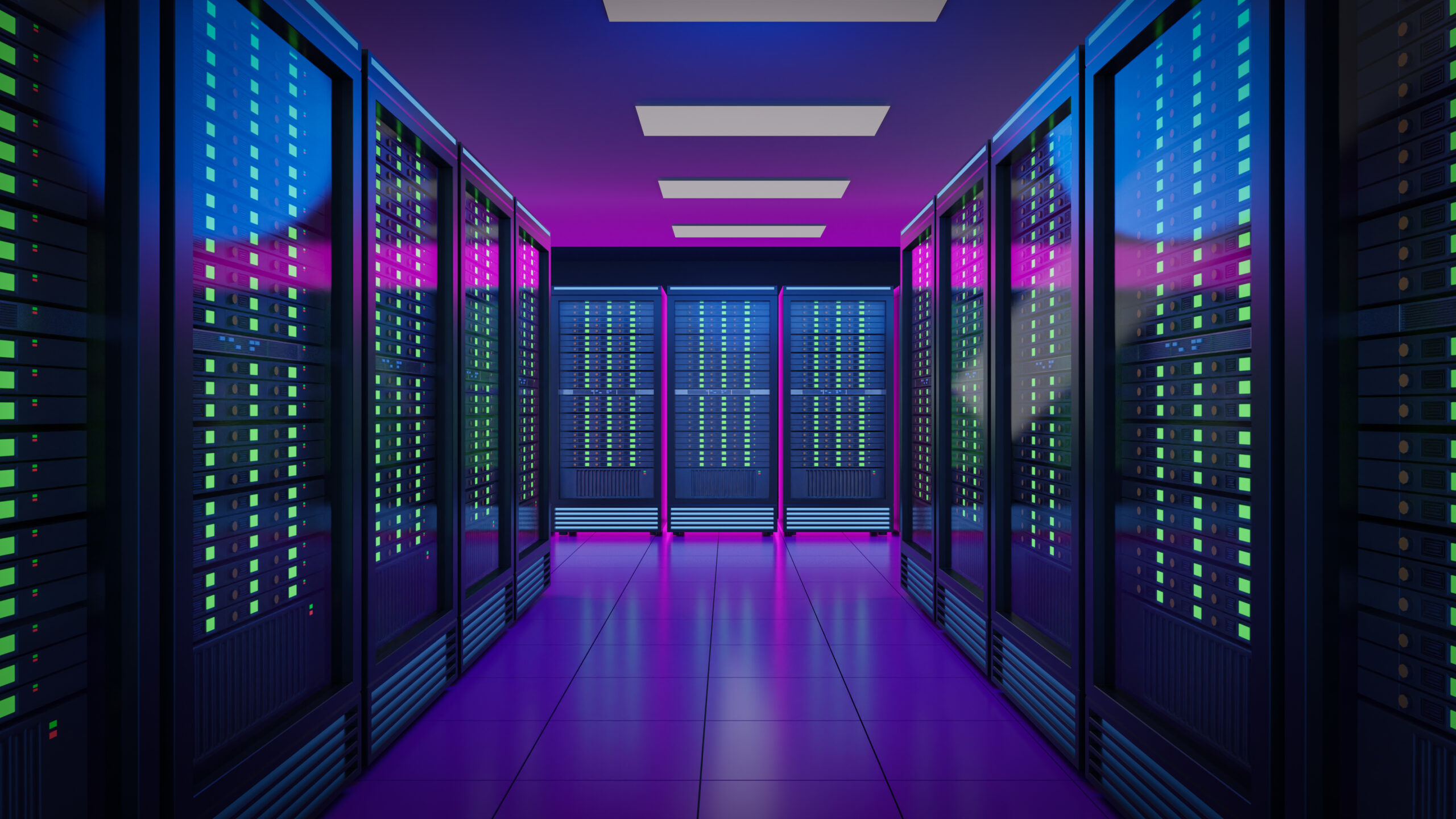
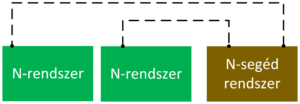
The most obvious problem for data centers is downtime, and this is the main driver for redundancy, i.e., redundant systems. Among the many solutions for this problem are the power supply of these data centers, cooling systems or even the point of entry for telecommunication. Redundancy in data centers is a system design, which allows us to replace one component by another component. This means, that the high-security data storage can continue to operate without interruption in the event of a power or equipment failure, or any unexpected effect. Redundancy N: This is to show the degree of redundancy. We use several components in parallel, so that if one of the components fails or goes down, then the other can take its place. The letter N represents the number of devices/feeds that are necessary for normal operation. N+1 redundancy: This level of redundancy means that an additional is added to the components in use as a backup, so there is a spare element on which to rely in the event of a system failure or maintenance.
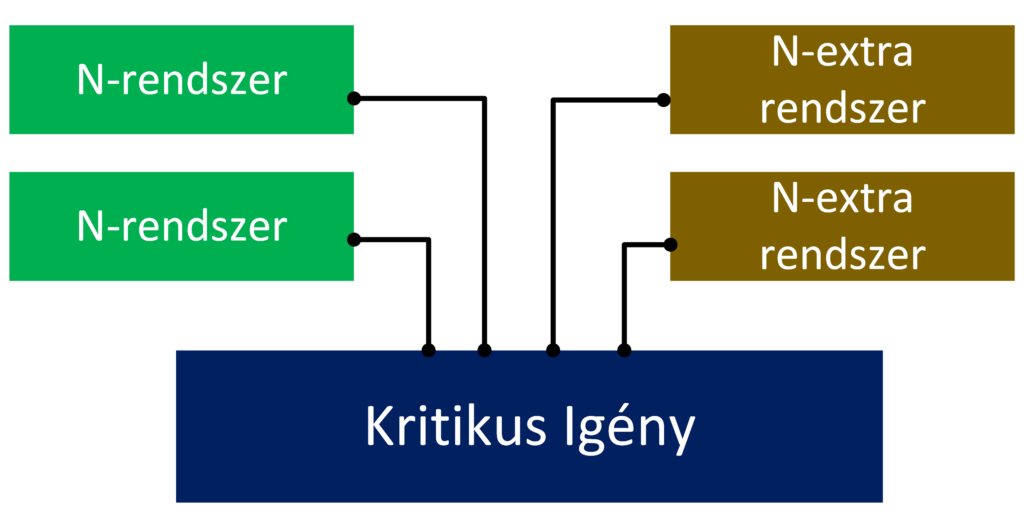
The point of the 2N system topologies is to feed a critical load to two equivalent, independent systems. So, if our critical system needs four cooling blocks to operate without any problems, eight cooling systems with 2N redundancy can be used. With this solution, should one or more of our priority systems fail, a backup system would be able to replace it. Our goal is to ensure that the system that needs to be protected does not detect any failure.
We can rightfully ask the question whether these systems are budget-friendly or not. Not only is the installation process of a completely mirrored system costly, but so is the operation of it. Besides all of that, there are some clients for whom high security is extremely important, such as the public health care system or the financial partners. For them this luxury is essential.
Following the previous analogy, Shared Redundancy Systems can also be called 3N/2 systems. The point of this type of redundancy implementation is that the data center’s critical systems are distributed across multiple supply points. So, for instance, a critical system with a demand of 8MW power is supplied by four 2MW secondary systems.
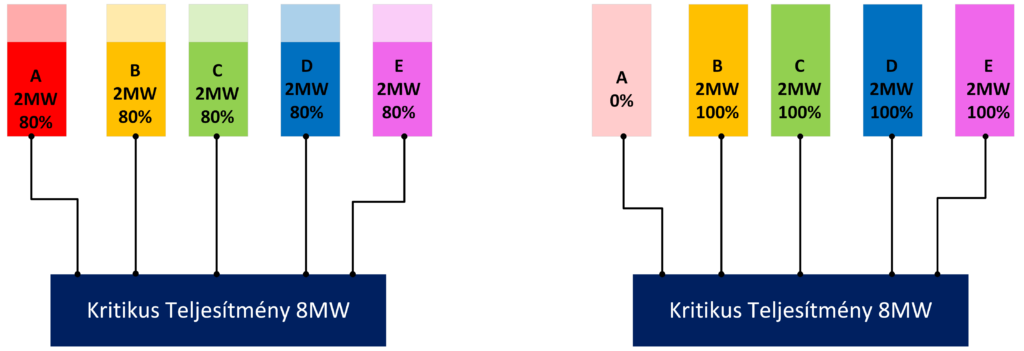
This in itself is not foolproof. We can make it so by distributing the total performance in a different way. The point of the solution is to use an extra block that has the same performance, then to distribute the whole critical system. This way, none of the secondary systems will be operating at nominal power, so in the event of a failure, the remaining systems can still take over the power demand of the loss.
Following the previous analogy, when it comes to block redundant systems, five subsystems are used for the demands of the four critical systems. With this solution, if one of our subsystems A; B; C or D fails, we can switch to the backup system R. Under normal circumstances, the backup system R is not operational.
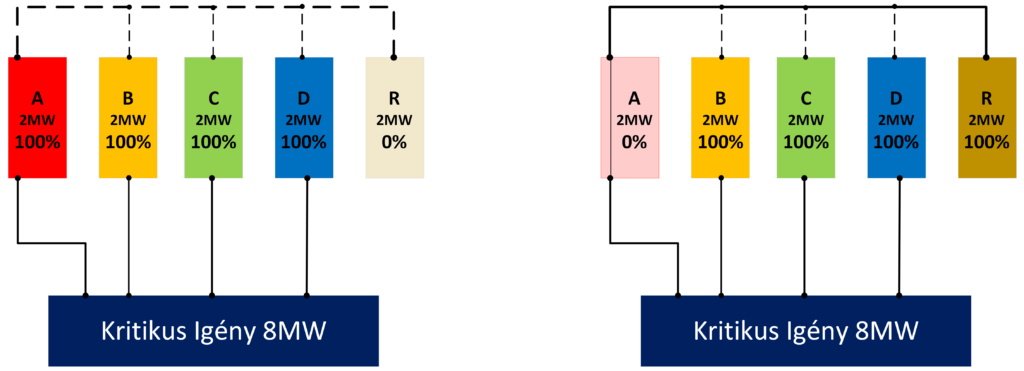
Its role is to kick in when one of the subsystems shuts down. Its advantage in contrast to the shared systems is that it can be more easily expanded in the future, and the distribution of demand can be more easily defined and managed.
There is no right or wrong redundancy system for solving the secure service issue, as every situation is different.
Author: Ádám Horváth, electrical engineer
Recent posts
From idea to impact
At IN-EX, we believe that our greatest asset is the knowledge, experience and curiosity of our people. The Innovation Hub was created to ensure that our engineers’ ideas do not remain isolated suggestions: we give them space, develop them together, and take initiatives that create real value all the way through to implementation.
Structural Challenges of an Automated Warehouse System and a BIM-Based Solution
Our project serves as a good example of how adapting existing industrial buildings to modern technologies can present a complex engineering challenge. The implementation of the automated high-bay warehouse system involved not only a technological conversionbut also the adaptation of an existing reinforced concrete hall structure to new operational, structural, and fire safety requirements.
New Technology, Existing Structure: A Steel Structural Solution for the Conversion of an Automated High-Bay Warehouse
During the interior conversion of a high-bay warehouse attached to a manufacturing plant, it became necessary to install a state-of-the-art automated storage system. In the first phase of the project, we were commissioned to assess, at the conceptual design stage, whether the existing structural framework was suitable for accommodating the new technological system and to determine what structural modifications would be required to implement the conversion.
One Office, One Model: The Benefits of 3D Design and Multidisciplinary Collaboration
STUDIO IN-EX is a multidisciplinary design studio where almost every design discipline is represented under one roof. Every day, our colleagues experience the benefits of having designers from different disciplines work side by side, within a shared closed BIM environment and in the same office. What are these benefits in practice? We spoke to Lilla Vámos, one of our low-voltage systems designers, about her experience.
Case Study: Saving on Investment Costs Through Smart Warehouse Design
We believe that the investment cost of a project can be influenced to a significant extent during the design phase. For this reason, our approach goes beyond simply meeting the applicable requirements. We also investigate alternative technical solutions that can provide the same level of technical performance and safety while resulting in lower investment costs.
Model Checking Is Not About Finding Errors
In model-based design, a BIM model is no longer just a 3D representation. A well-structured model contains geometry, information, and discipline-specific relationships in a single source of truth. It drives drawings, quantity take-offs, schedules, equipment lists, technical data deliverables, and serves as the common platform for multidisciplinary coordination.