Blog
The Art of Accountability at IN-EX: Transforming Control into Motivation

In the Hungarian language, the word „számonkérés” (accountability/review) often carries an ominous, tense undertone. Hearing this term, many instantly think of strict reprimands, blame, or micromanagement. At IN-EX, however, we have completely redefined this concept. For us, accountability is not a retrospective punitive tool, but the cornerstone of transparent collaboration and continuous development – which is precisely why every new employee masters this mindset during a dedicated training session.
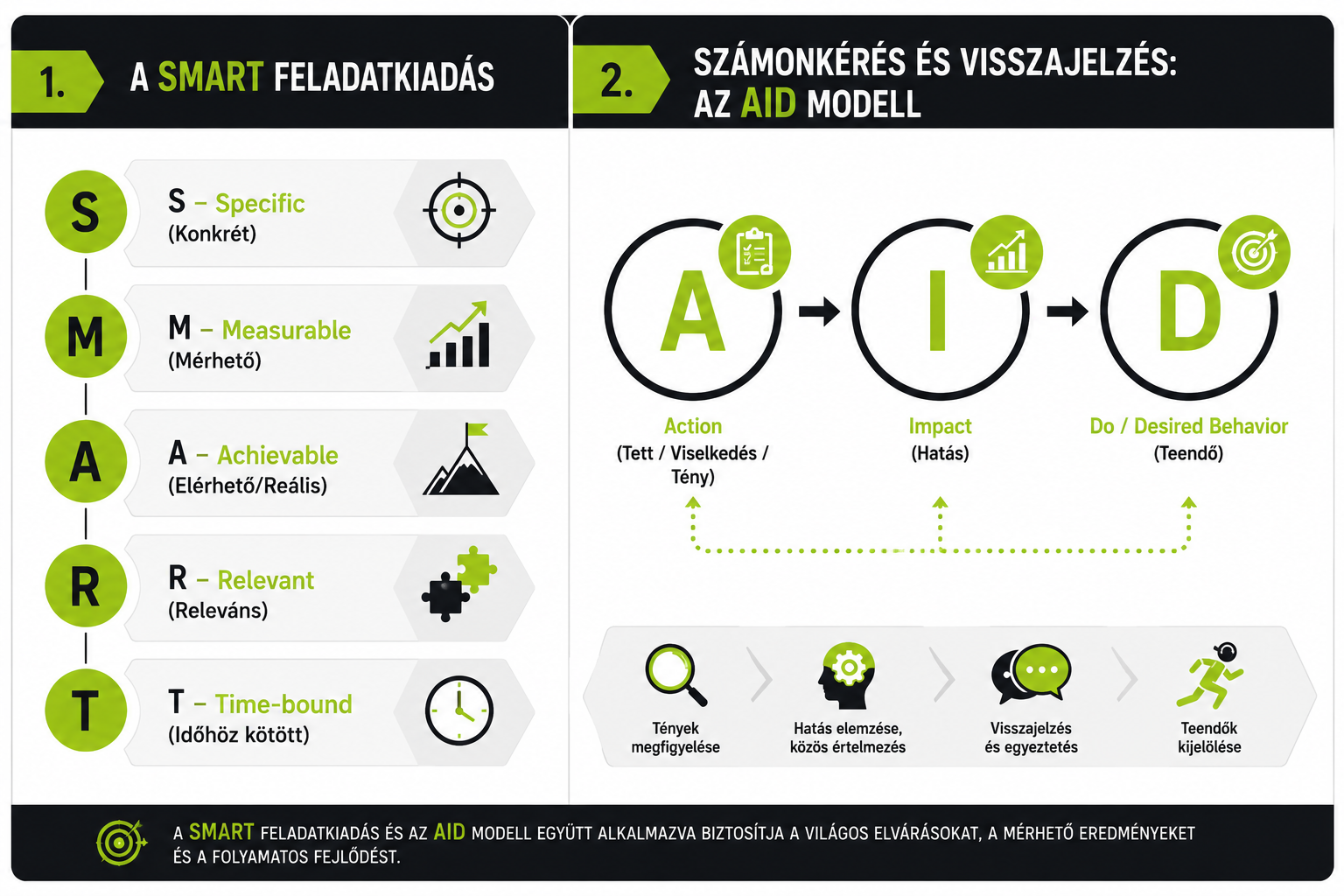
In our approach, accountability encompasses both positive and constructive feedback. Its goal is not to find someone to blame, but to ensure project success and provide professional support for our colleagues. To achieve this, we use two highly effective tools: the SMART framework for assigning tasks, and the AID model for accountability and feedback.
- The Foundation of Successful Accountability: SMART Task Delegation
You cannot hold someone accountable for accuracy if the task was defined vaguely in the first place. The quality of accountability depends 90% on the quality of task delegation. Therefore, at IN-EX, we apply the SMART framework to every delegation:
- S – Specific: What exactly needs to be done? Avoid broad, vague phrasings.
- M – Measurable: How do we know it is finished? What is the qualitative or quantitative indicator?
- A – Achievable: Are the necessary resources, data, and competencies available?
- R – Relevant: Why is this important for the project or the team as a whole?
- T – Time-bound: When does it need to be completed? (“Urgent” and “yesterday” are not deadlines).
Poor example (Non-SMART): „Peti, please review the MEP model this week because I think there are too many clashes.” (Not specific, not measurable, no precise deadline).
SMART example from IN-EX practice: „Peti, please run a clash detection between the MEP and the structural models in the 2nd-floor zone. Send the report on the critical (hard) clashes by Thursday at 2:00 PM, so we can already decide on solutions during Friday’s coordination meeting.”
- Accountability and Feedback: The AID Model
If a task is delegated in a SMART way, accountability is no longer a subjective argument, but a conversation based on objective facts. This is where we use the AID model, which helps ensure that feedback (whether praise or correction) is clear, understandable, and forward-looking.
The AID acronym consists of the following steps:
- A – Action (Fact / Behavior): We describe the specific, observable fact or action that occurred. It is crucial that there is no room for judgment or generalization here (e.g., “you are always late”, “you are not paying attention”). Only facts matter.
- I – Impact: We explain the direct impact this action had on the project, the team, the office, or the Client. This provides the weight of the action.
- D – Do / Desired Behavior: We formulate the next step. In the case of positive feedback, this reinforces the behavior; for negative feedback, it clarifies the corrective plan and future expectations.
AID in Practice: Examples from Everyday Life at IN-EX
Let’s see how this works in practice with both positive and negative scenarios!
- A) Positive Accountability (Recognition and Reinforcement)
Many forget, but well-executed work must also be reviewed – meaning, it must be made visible.
- Action: „Gábor, I saw that during yesterday’s Client presentation, you didn’t just present the modified MEP routes, but you came prepared with two alternative cost estimates for different pipe materials.”
- Impact: „This preparedness highly impressed the investor; their initial hesitation vanished instantly, and they gave us the green light to proceed. Plus, you saved the team at least a week of unnecessary redesign work.”
- Do: „Thank you very much for this proactivity! Let’s apply this structured approach to key projects in the future as well. Please share how you structured this logic with the rest of the team at the next project kick-off.”
- B) Corrective Accountability (Negative, yet Constructive Feedback)
When something does not go according to plan, AID helps prevent the conversation from turning personal.
- Action: „Dóra, I finally received the BIM coordination report, which was scheduled for Thursday at 2:00 PM, only on Friday morning. On top of that, the electrical discipline model was missing from it.”
- Impact: „Because of this, we couldn’t coordinate effectively with the electrical designer during Friday morning’s meeting, and the architectural team was forced to halt their work since they didn’t know where the main containment routes could run. This delay now affects the weekend scheduling of the entire office.”
- Do: „Let’s discuss what caused the bottleneck. In the future, if you see that a discipline is not delivering data on time, please notify me immediately, 24 hours before the deadline, so I can help escalate the issue. For now, let’s sit down and figure out how we can make up for this missing data by this afternoon.”
At IN-EX, we place such a strong emphasis on teaching the SMART and AID methodologies because we believe that predictability and clear communication form the foundation of high-quality engineering work.
For us, accountability is not a tool of fear, but one of professional security. When tasks are clear (SMART) and feedback is fact-based and constructive (AID), team members know exactly where they stand, where they excel, and where they still need to grow. This is how accountability becomes an internal, supportive driving force.
Author: Norbert Pekola, Studioleader
Recent posts
Case Study: Saving on Investment Costs Through Smart Warehouse Design
We believe that the investment cost of a project can be influenced to a significant extent during the design phase. For this reason, our approach goes beyond simply meeting the applicable requirements. We also investigate alternative technical solutions that can provide the same level of technical performance and safety while resulting in lower investment costs.
Model Checking Is Not About Finding Errors
In model-based design, a BIM model is no longer just a 3D representation. A well-structured model contains geometry, information, and discipline-specific relationships in a single source of truth. It drives drawings, quantity take-offs, schedules, equipment lists, technical data deliverables, and serves as the common platform for multidisciplinary coordination.
Innovative Operational Development Based on BIM
We had the opportunity to present at the PropTech Hungary 2026 Conference the operational approach that STUDIO IN-EX has been developing over the past several years. It is a great honour for us that our submission was awarded 2nd place in the Corporate Innovator category.
Challenges in waterproofing design
Our task in this project was to prepare the detailed design documentation for the expansion of a pharmaceutical manufacturing plant. A major technical challenge during the design phase was that the development area is located in the floodplain of the Gyöngyös stream.
Symbiosis at the Design Table: How Mechanical Engineering and Building Automation Merged at STUDIO IN-EX
One of the greatest advantages of a closed BIM based design process is its ability to continuously reveal new opportunities for improvement.
The Art of Accountability at IN-EX: Transforming Control into Motivation
For us, accountability is not a tool of fear, but one of professional security. When tasks are clear (SMART) and feedback is fact-based and constructive (AID), team members know exactly where they stand, where they excel, and where they still need to grow. This is how accountability becomes an internal, supportive driving force.