
Blog
Shading the pilgrimage route, Mina, Saudi Arabia

Our office has been commissioned to design the shading of the religious pilgrimage route linking Mount Arafat to Mecca in Mina, Saudi Arabia. The primary aim of the investment was to make the long and arduous walk more comfortable for the pilgrims. We had to design the shading in a way that local contractors could build a timeless system as easily and accurately as possible.
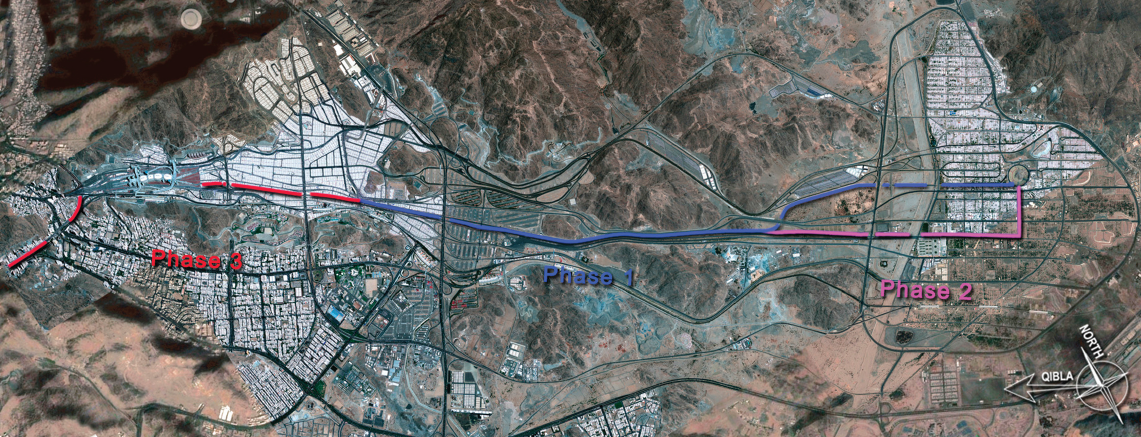
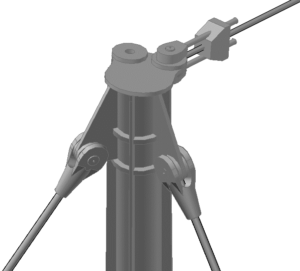
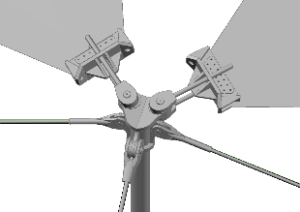
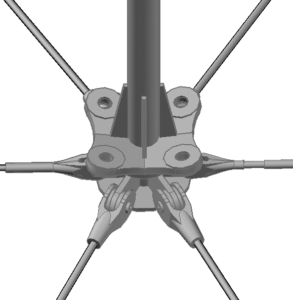
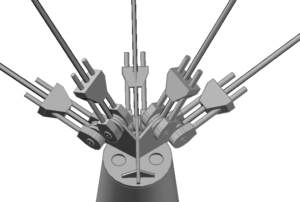
The site is huge in architectural scale; we designed nearly 600,000 square metres of shading over the 30m wide and 20 km long pilgrimage route. Studio IN-EX is responsible for the architecture and the design coordination of this unconventional design project, which also had to meet local needs. The structural design was led by Dr. Dezső Hegyi, a renowned designer, espacially in the field of tent and membrane structures. The biggest challenge for us was to create a typified system of mostly uniform elements that could be easily assembled on site, along the entire length of the road, adapting to the changing environmental conditions – junctions, bends with different angles, tunnels, bridges, roadside rocks, landmarks. The solution was found in a membrane system stretched on a steel frame structure on masts, with uniform elements that can be prefabricated and easily constructed on each section of the road, based on easy-to-understand installation drawings.
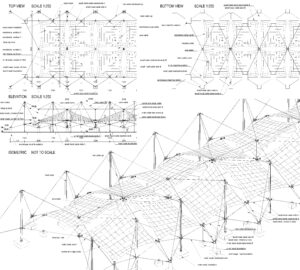
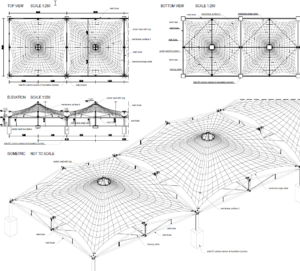
In line with the construction schedule, the area was divided into zones corresponding to the construction phases. In addition to the zones, economic feasibility was also an important objective, so we aimed to ensure that each module could stand on its own without the need to double the supporting columns and beams. We designed the system with as few different types of elements as possible, so we ended up with 2 main module units, which could cover the whole distance complemented by a few individual elements in specific locations.
On the general, the desert section of the road, we chose a solution without internal supports, which does not impede the free flow of pilgrims. Since the repetitive module sizes had to cover large spans (30x30m), this was solved by “tying” the structure to the side, using so-called tieback anchoring. In urban areas, where anchoring was not possible due to space constraints, but the faster flow of the uprushing mass required the use of lanes, we provided support by using central columns.
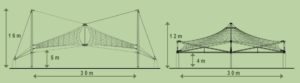
In these sections, two 15-metre-wide flow zones (equivalent to about 5 traffic lanes) were created with barriers in the middle or fences.
All the elements of the steel structures, their foundations and anchorages were specified based on detailed drawings and schedules. The spatially curved awning elements were created using special software, according to a 3D pattern.
In addition to shading, the concept also included the installation of humidification systems under the tents and the upgrading of some roadside sanitary blocks. The designing process itself took several months: it started with the detailed geodetic survey of the road and its surroundings and ended with the construction designs, including the product drawings.
We are proud to have been part of such an internationally unique and large-scale project.
Author: Péter Gáti, stúdió leader
Recent posts
Career Orientation Day in Our Debrecen Office
During a career orientation day at the STUDIO IN-EX Debrecen office, we provided insight into the workflow and complexity of BIM-based integrated design.
The role of copyright in design
Before signing a design contract, it is crucial for every designer to familiarise themselves with copyright issues, which are almost always included in contracts. In the seecond part of our legal blog series, we highlight the role of copyright in design.
What is the fundamental difference between additional and supplementary work?
One of the greatest difficulties for designers during design projects is determining when requests arising from the client’s expectations or designs prepared based on the contract between the parties can be considered additional or supplementary work.
Show us where you work – A day at STUDIO IN-EX through the eyes of children
We celebrated one of the happiest days of Spring at STUDIO IN-EX: it was the MUTIHOLDOLGOZOL DAY, also known as “Show me where you work”, when children could enter the world of adults, specifically the exciting universe of architects, mechanical, electrical and structural engineers.
Hydro Extrusion – Office with a Minimalist Design
Hydro Extrusion Hungary Kft. is a subsidiary of a Norwegian parent company, so an important aspect of the interior design process was to ensure that the minimalist aesthetic and the company’s brand colors are harmoniously reflected throughout the interior spaces.
Professional day for students of civil engineering
Students from Zielinski Szilárd College of Civil Engineering have just participated in an exciting professional visit to the STUDIO IN-EX general design office.