Blog
The types of redundancy

Nowadays, it would be hard to imagine a world without the possibility to access our social media accounts, our data or any services on the internet. To provide data these services, it is essential that data and internet-based services are secured and made available, and this is what data centers are responsible for.
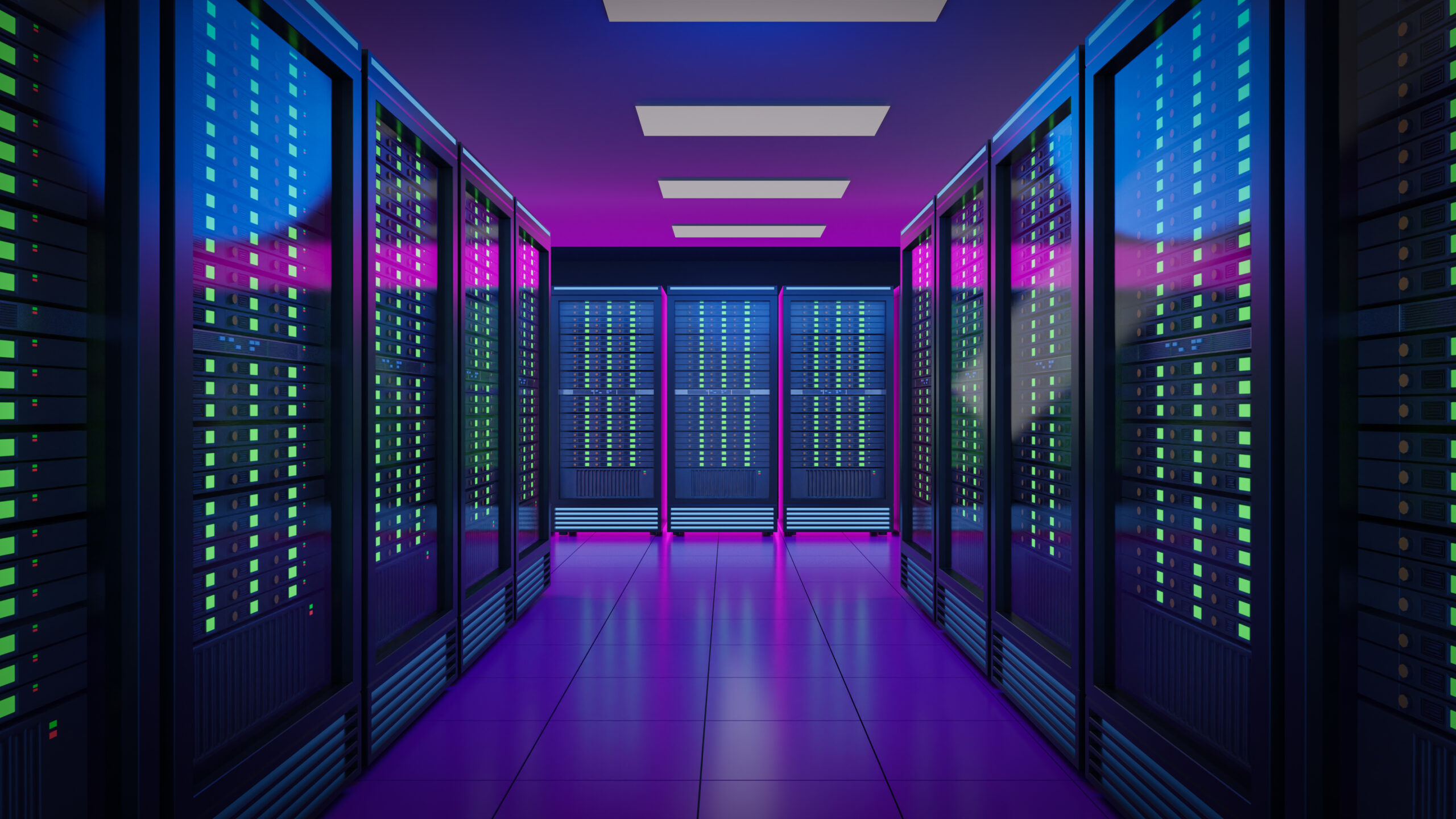
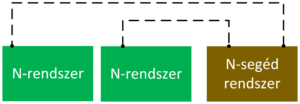
The most obvious problem for data centers is downtime, and this is the main driver for redundancy, i.e., redundant systems. Among the many solutions for this problem are the power supply of these data centers, cooling systems or even the point of entry for telecommunication. Redundancy in data centers is a system design, which allows us to replace one component by another component. This means, that the high-security data storage can continue to operate without interruption in the event of a power or equipment failure, or any unexpected effect. Redundancy N: This is to show the degree of redundancy. We use several components in parallel, so that if one of the components fails or goes down, then the other can take its place. The letter N represents the number of devices/feeds that are necessary for normal operation. N+1 redundancy: This level of redundancy means that an additional is added to the components in use as a backup, so there is a spare element on which to rely in the event of a system failure or maintenance.
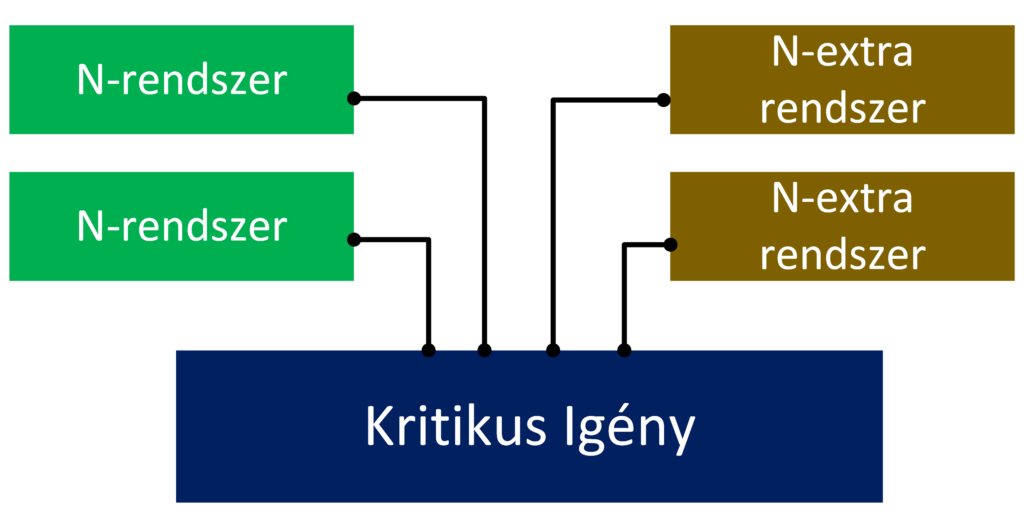
The point of the 2N system topologies is to feed a critical load to two equivalent, independent systems. So, if our critical system needs four cooling blocks to operate without any problems, eight cooling systems with 2N redundancy can be used. With this solution, should one or more of our priority systems fail, a backup system would be able to replace it. Our goal is to ensure that the system that needs to be protected does not detect any failure.
We can rightfully ask the question whether these systems are budget-friendly or not. Not only is the installation process of a completely mirrored system costly, but so is the operation of it. Besides all of that, there are some clients for whom high security is extremely important, such as the public health care system or the financial partners. For them this luxury is essential.
Following the previous analogy, Shared Redundancy Systems can also be called 3N/2 systems. The point of this type of redundancy implementation is that the data center’s critical systems are distributed across multiple supply points. So, for instance, a critical system with a demand of 8MW power is supplied by four 2MW secondary systems.
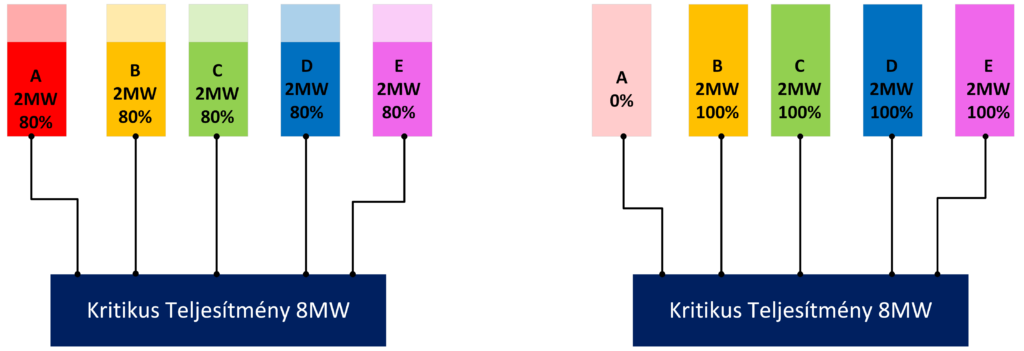
This in itself is not foolproof. We can make it so by distributing the total performance in a different way. The point of the solution is to use an extra block that has the same performance, then to distribute the whole critical system. This way, none of the secondary systems will be operating at nominal power, so in the event of a failure, the remaining systems can still take over the power demand of the loss.
Following the previous analogy, when it comes to block redundant systems, five subsystems are used for the demands of the four critical systems. With this solution, if one of our subsystems A; B; C or D fails, we can switch to the backup system R. Under normal circumstances, the backup system R is not operational.
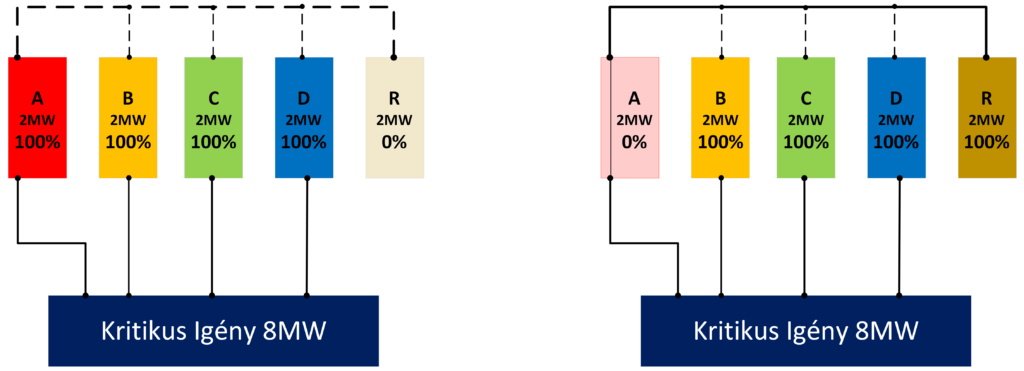
Its role is to kick in when one of the subsystems shuts down. Its advantage in contrast to the shared systems is that it can be more easily expanded in the future, and the distribution of demand can be more easily defined and managed.
There is no right or wrong redundancy system for solving the secure service issue, as every situation is different.
Author: Ádám Horváth, electrical engineer
Recent posts
Career Orientation Day in Our Debrecen Office
During a career orientation day at the STUDIO IN-EX Debrecen office, we provided insight into the workflow and complexity of BIM-based integrated design.
The role of copyright in design
Before signing a design contract, it is crucial for every designer to familiarise themselves with copyright issues, which are almost always included in contracts. In the seecond part of our legal blog series, we highlight the role of copyright in design.
What is the fundamental difference between additional and supplementary work?
One of the greatest difficulties for designers during design projects is determining when requests arising from the client’s expectations or designs prepared based on the contract between the parties can be considered additional or supplementary work.
Show us where you work – A day at STUDIO IN-EX through the eyes of children
We celebrated one of the happiest days of Spring at STUDIO IN-EX: it was the MUTIHOLDOLGOZOL DAY, also known as “Show me where you work”, when children could enter the world of adults, specifically the exciting universe of architects, mechanical, electrical and structural engineers.
Hydro Extrusion – Office with a Minimalist Design
Hydro Extrusion Hungary Kft. is a subsidiary of a Norwegian parent company, so an important aspect of the interior design process was to ensure that the minimalist aesthetic and the company’s brand colors are harmoniously reflected throughout the interior spaces.
Professional day for students of civil engineering
Students from Zielinski Szilárd College of Civil Engineering have just participated in an exciting professional visit to the STUDIO IN-EX general design office.